Reset Sleep and Mornings
A gentle, practical plan to help children aged 10–14 shift from holiday sleep patterns to school mornings while protecting adequate sleep and involving the child in the routine.
Kids Learn With Concept
Printable worksheets and engaging e-books covering core subjects, with clear concepts, practice activities, and answer keys for effective learning at every grade level.

Concept-first PDF workbooks for Pre-Nursery to Class 12, each with a complete answer key for parents. Download once, then print and practise as often as you like.
Digital products — delivered instantly, so all purchases are final (refund & cancellation policy). Your download link stays active for 7 days, so please save the file.
Search by subject, class or what is inside — “place value”, “answer key”, “class 3”.
₹70 ₹49 (incl. 5% GST) Save ₹21
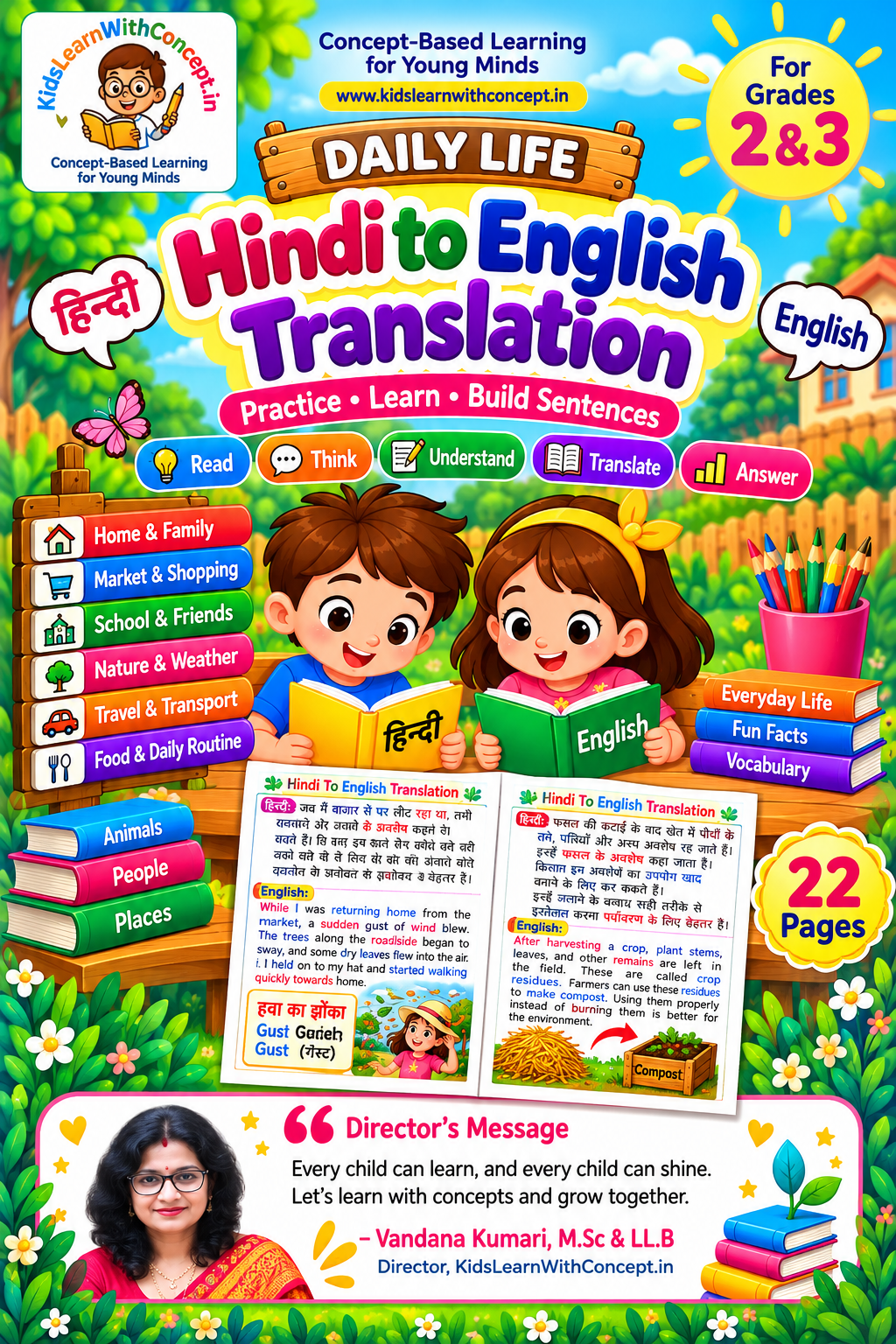
Twenty everyday Hindi passages, each one translated into English line by line — and every English word carries its Hindi pronunciation underneath it. 🗣️ That second line is the whole point: a child who can read returning but has no idea how to say it will not use the word, and a dictionary will not tell them. Printing रिटर्निंग under it does. 📖 The passages are ordinary life, not textbook life: a sudden gust of wind on the way home, crop residue left in a field, a pothole on the road, tangled hair, pruning a plant, frost, a moss-covered well, the milkman, buying vegetables, a water leak, a cloud of dust, a crack in the wall, sweeping the house, the alarm going off, forgetting the keys, a phone battery running out, heating milk, an electricity cut. These are the things a child actually wants to describe and cannot. ✏️ Each page ends with a vocabulary box pulling out the one word the passage was built around — gust, crop residue, pothole — with its Hindi meaning and a picture. 👩🏫 Written by educator Vandana Kumari (M.Sc, LL.B). Two passages are free — look under Worksheets/Notes/Samples below. Download once, print & practise again and again! 🌟
₹70 ₹49 (incl. 5% GST) Save ₹21
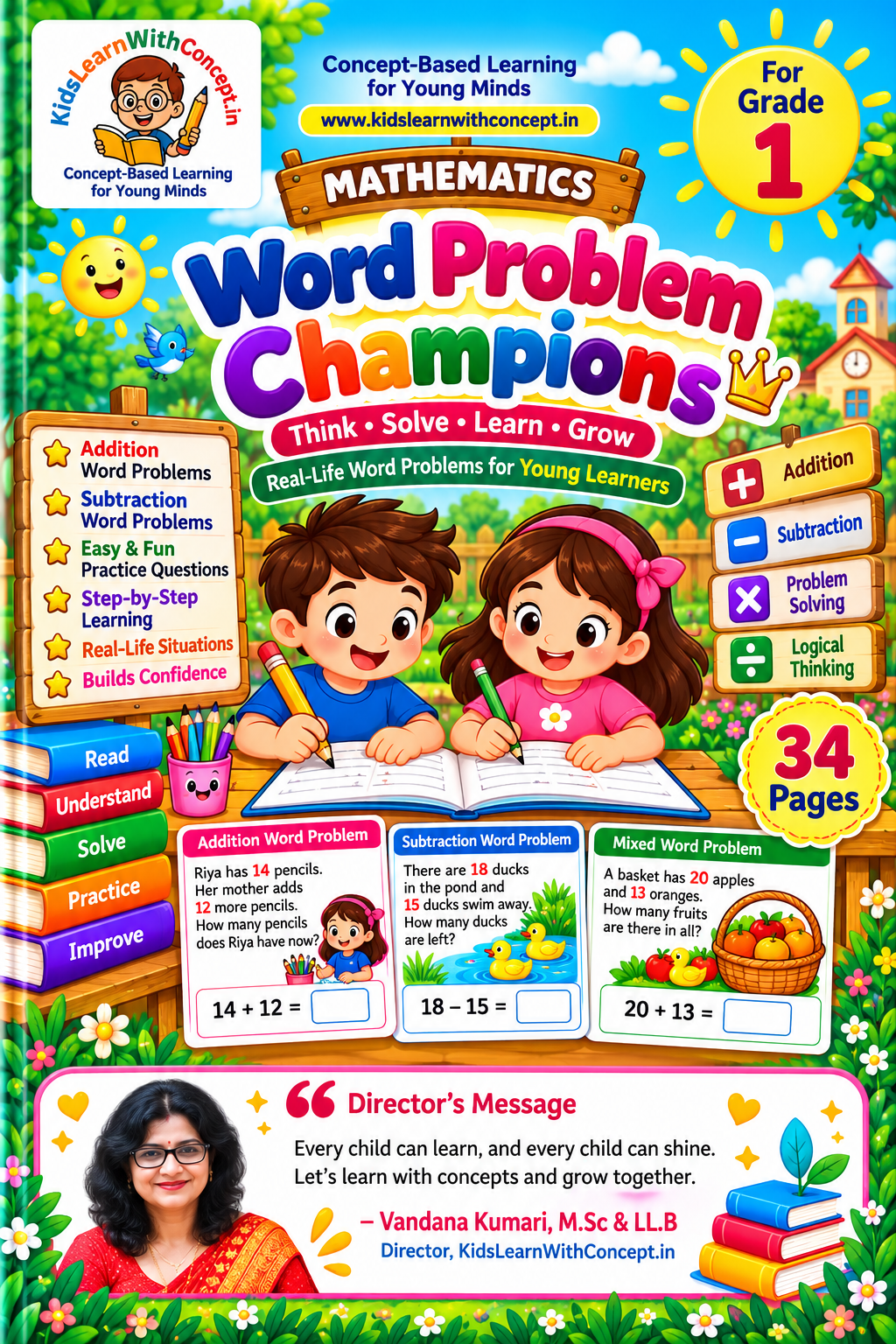
The book for the child who can add and subtract perfectly — until the sum is hidden inside a sentence. 🔑 It starts with the key words, not the sums. Before a single problem, two pages teach the words that tell you what to do: add, and, together, in all, both, more, altogether, total, combined for addition; take away, lose, less, give away, spent, fewer, left, remain for subtraction. A Grade 1 child who can spot those words has solved the hard part of every word problem they will meet this year. 🧮 Then 30 problems, 15 of each. Every one has a picture, the key word highlighted in the sentence, and a T | O box to set the sum out properly — so the child shows the working instead of guessing a number. 🍎 Real things a six-year-old can picture: stickers, red balls, apples, marbles, pencils, rupees, balloons, classroom chairs. 👩🏫 Written by educator Vandana Kumari (M.Sc, LL.B). Two pages are free — look under Worksheets/Notes/Samples below. Download once, print & practise again and again! 🌟
₹40 ₹20 (incl. 5% GST) Save ₹20
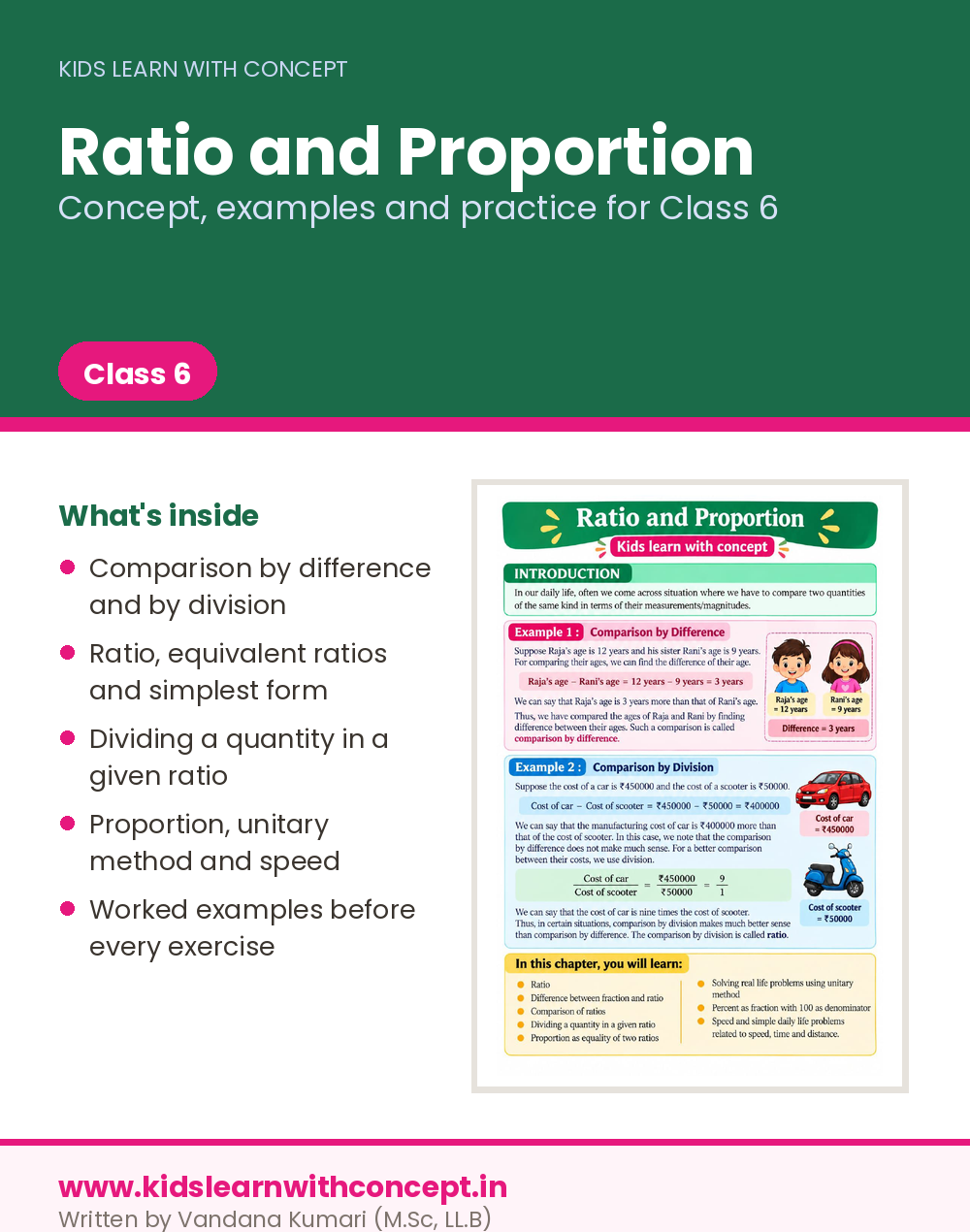
Ratio and proportion for Class 6, taught the way it should be: the idea first, then the sums. ⚖️ It opens with the question most books skip — when you compare two quantities, should you subtract or divide? Raja is 12 and Rani is 9, so Raja is 3 years older; but a car costs ₹4,50,000 and a scooter ₹50,000, and saying the car costs ₹4,00,000 more tells you almost nothing — saying it costs nine times as much tells you everything. Once a child sees why division is the better comparison, ratio stops being a notation to memorise. 📐 Then the full chapter: the terms of a ratio (antecedent and consequent), equivalent ratios, simplest form, dividing a quantity in a given ratio, proportion as equality of two ratios, the unitary method, percentage as a ratio with 100 as denominator, and speed and distance. 💡 Every exercise is preceded by a worked example, so a child who is stuck has somewhere to look that is not the answer. 👩🏫 Written by educator Vandana Kumari (M.Sc, LL.B). Two pages are free — see Worksheets/Notes/Samples below. 🌟
₹30 ₹10 (incl. 5% GST) Save ₹20
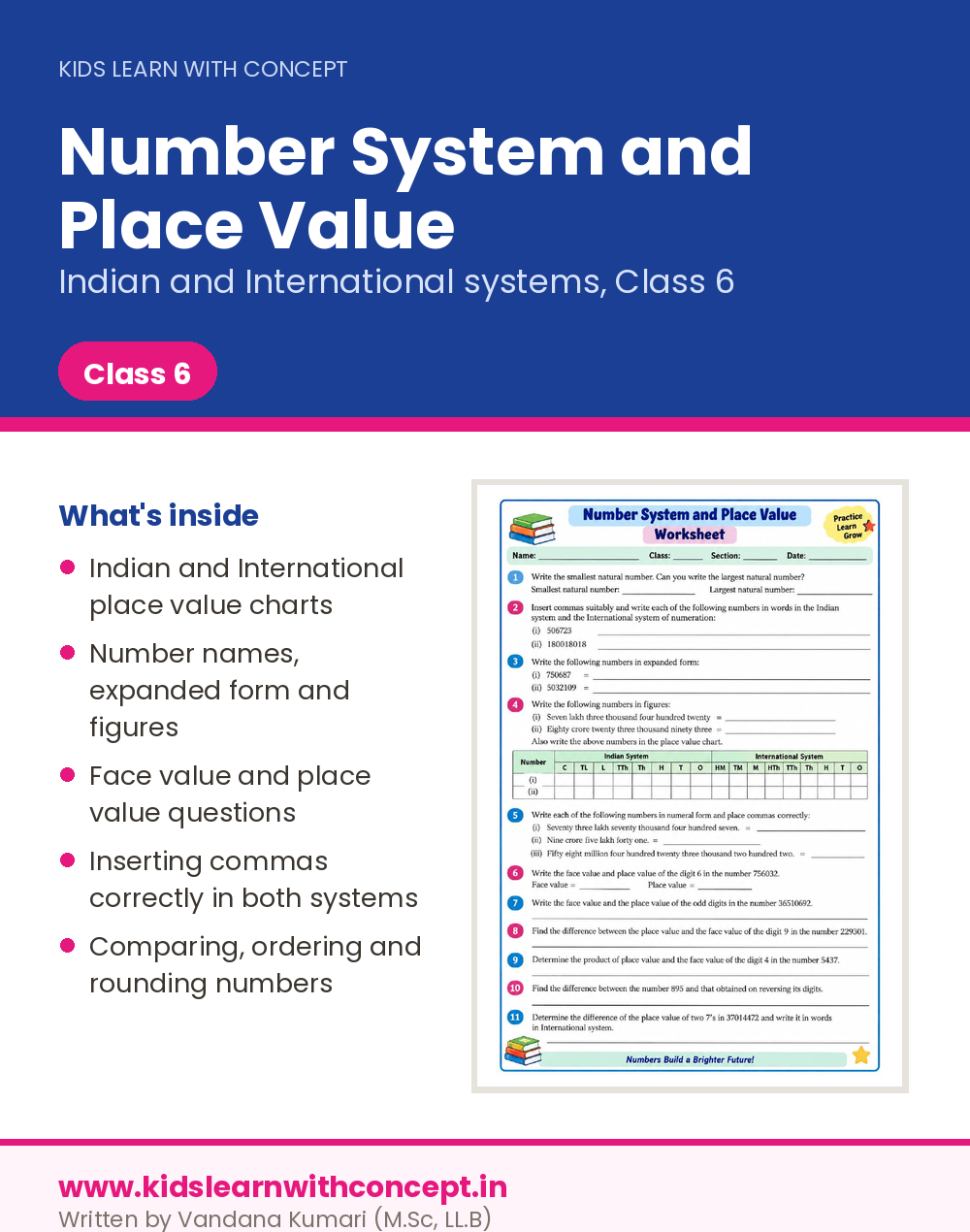
Sixteen worksheet pages on the one Class 6 topic that quietly breaks everything after it: place value in two different systems. 🔢 Indian and International charts side by side — crore, ten lakh, lakh, ten thousand against million, hundred thousand, ten thousand — and the comma placement that goes with each. A child who puts the commas in the Indian places and then reads the number as millions gets every large-number question wrong for a year, and nobody can see why. ✏️ What the pages ask for: write the smallest and largest natural number from given digits (with and without repetition), insert commas in both systems and write the number in words, expanded form, figures from words, face value and place value and the difference between them, and comparing and ordering large numbers. 🧩 Finishes with word problems on large numbers — notebooks in a factory, pages printed in a day, cloth cut from a roll — so the place value work has somewhere to land. 👩🏫 Written by educator Vandana Kumari (M.Sc, LL.B). Two pages are free — see Worksheets/Notes/Samples below. 🌟
₹80 ₹49 (incl. 5% GST) Save ₹31
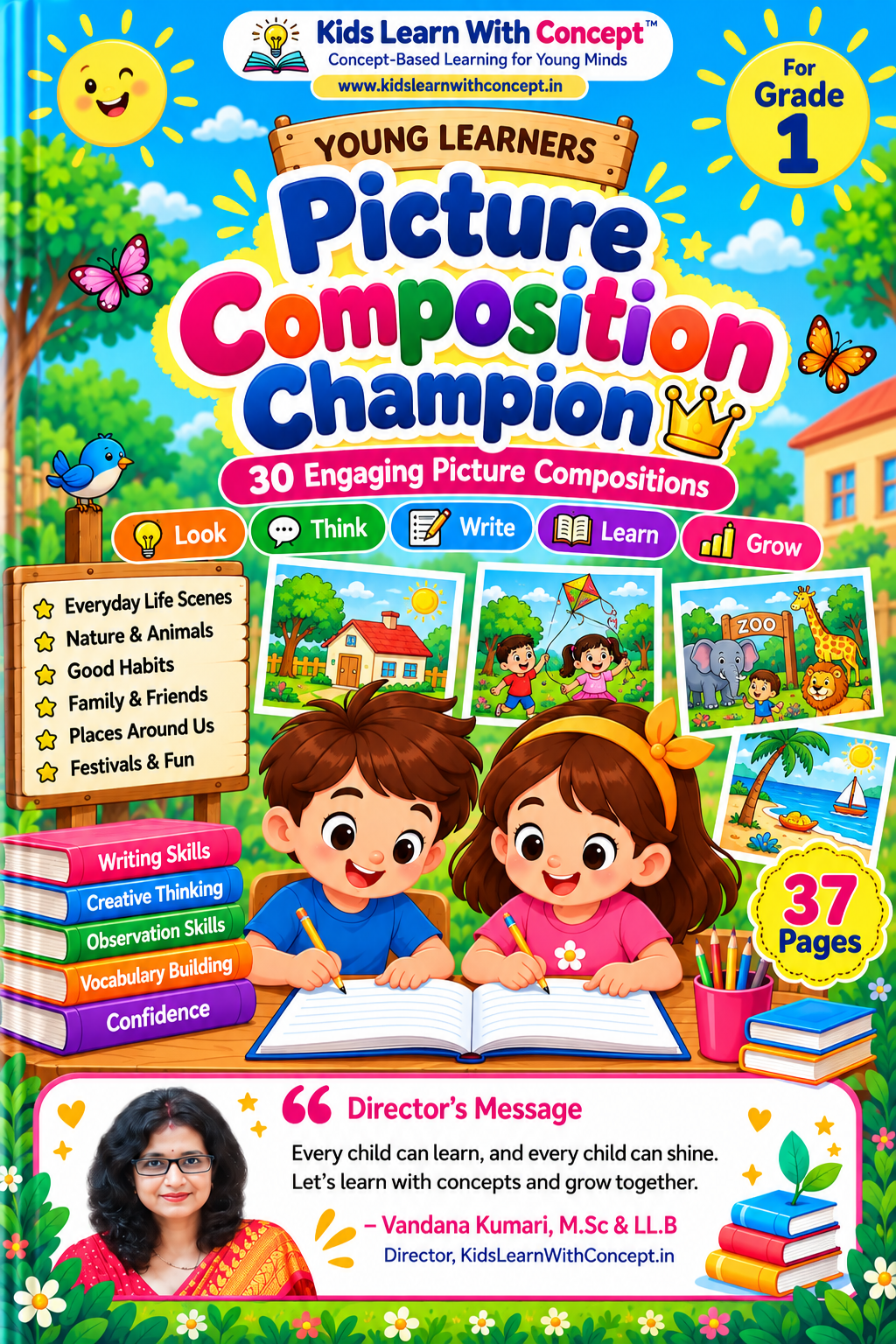
The first writing book a Grade 1 child can finish on their own. 30 full-colour pictures, each on its own page, each asking for exactly four simple sentences — short enough that a six-year-old starts instead of stalling. 🏠 Everyday scenes a six-year-old already has words for: a house, a kite in the park, the zoo, a boat on the sea, the school bus, a garden full of butterflies, a cow by the barn, the playground slide, a birthday party, a rainy day, a snowman, a family picnic, the night sky, a deer in the forest, a busy road, mother in the kitchen, a cat with a ball, a bird's nest, a boat on the lake, a pet dog, a tree house, the fruit shop, a day at the beach and bedtime with a teddy bear. ✏️ Helping words are printed under every picture — house, tree, sun, door, window — so a child who can read but freezes at a blank page has somewhere to start. 🌟 Picture 1 is already solved for you. The second page shows the same house with its four sentences written out, so you can read it together and the child sees the shape of the answer before writing a single word. That one page is what turns “I don't know what to write” into a first sentence. 🔑 Model answers for all 30 pictures are at the back, four short sentences each, plus a note for parents and teachers on how to mark picture composition — because there is no single right answer, and knowing what to look for matters more than a key. 👩🏫 Written by educator Vandana Kumari (M.Sc, LL.B) using the KidsLearnWithConcept approach. Two of these sheets are free — look under Worksheets/Notes/Samples below. Download once, print & practise again and again! 🌟
₹80 ₹49 (incl. 5% GST) Save ₹31
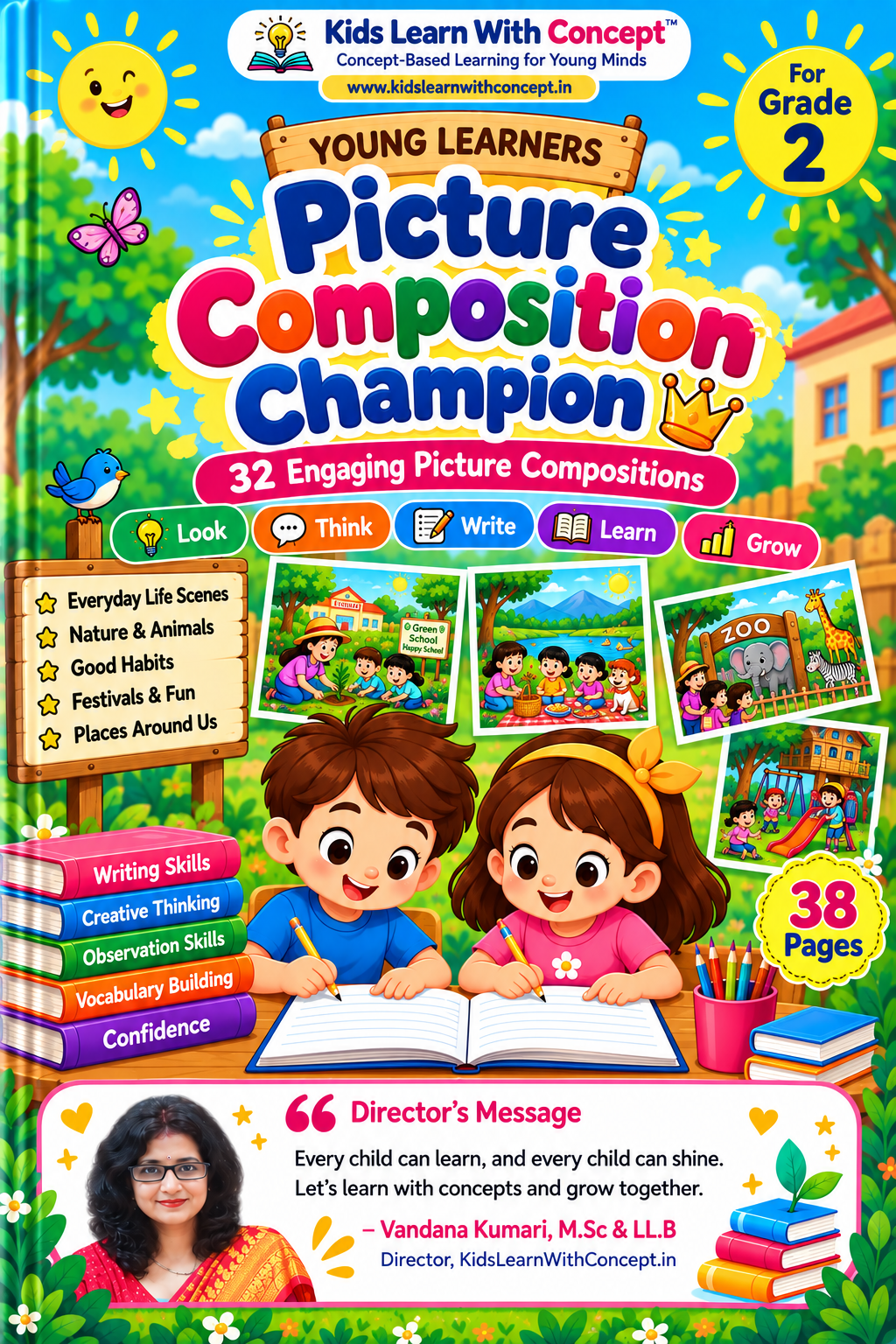
The next step up from Grade 1: 32 full-colour pictures, each asking for eight to ten sentences — the length a Class 2 or Class 3 child is expected to write in school. 🏫 Scenes with enough going on to fill ten lines: our school garden, a picnic by the lake, a visit to the zoo, camping by the lake, the playground, going to school, a birthday party, a day at the beach, planting in the garden, baking in the kitchen, the school library, a winter day, a visit to the farm, crossing the road safely, the vegetable market, a football match, drawing and craft time, flying kites, the lantern festival, story time, a visit to the doctor, cleaning the beach, playing with pets, planting trees, reading at home, the fun fair, a rainy day, playing in the park, making cookies with mother, camping under the stars, keeping our park clean and an evening in the park. ✏️ Every page carries a helping-words box and ten ruled lines, so the child knows exactly how much is wanted. 🔑 Model answers for all 32 pictures at the back, plus a note for parents and teachers — including the one extra step that moves a Class 3 child from describing a picture to composing about it: one sentence on what might happen next, or how the people in the picture feel. 👩🏫 Written by educator Vandana Kumari (M.Sc, LL.B). Two of these sheets are free — look under Worksheets/Notes/Samples below. Download once, print & practise again and again! 🌟
₹50 ₹30 (incl. 5% GST) Save ₹20
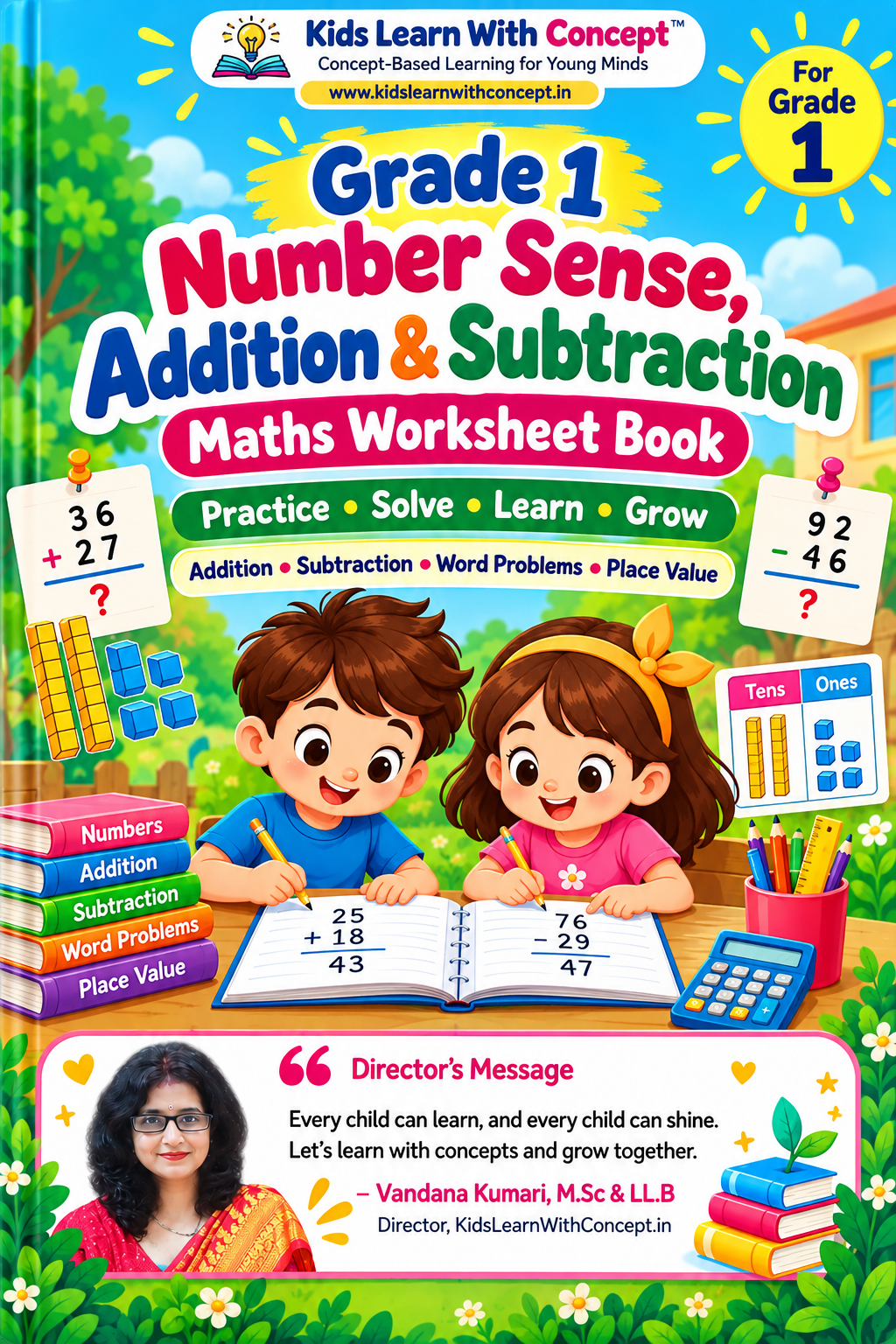
33 ready-to-print worksheets that take a Grade 1 child through tens and ones, and then through adding and subtracting with them. 🧮 Sixteen addition and subtraction sheets: every sum is set out in proper T | O columns so the child learns to line up tens under tens and ones under ones — the habit that stops most early carrying mistakes — with five additions and five subtractions on each page. 🍎 Word problems on every one of those pages: baskets of bananas and oranges, boxes of pencils and marbles, jars of crayons, packs of stickers. The child has to work out whether to add or subtract before touching the numbers, which is the part a page of bare sums never teaches. 📊 Seventeen place value sheets: draw the beads on the abacus for a given number and write its tens and ones; write number names; put a set of numbers in ascending and then descending order; build the number from “6 tens and 4 ones”; and compare pairs with >, < and =. ✏️ Big print, generous writing boxes and a picture beside every word problem, so a six-year-old can work through a page on their own. 👩🏫 Written by educator Vandana Kumari (M.Sc, LL.B) using the KidsLearnWithConcept approach. Four of these worksheets are free — look under Worksheets/Notes/Samples below. Download once, print & practise again and again! 🌟
₹200 ₹149 (incl. 5% GST) Save ₹51
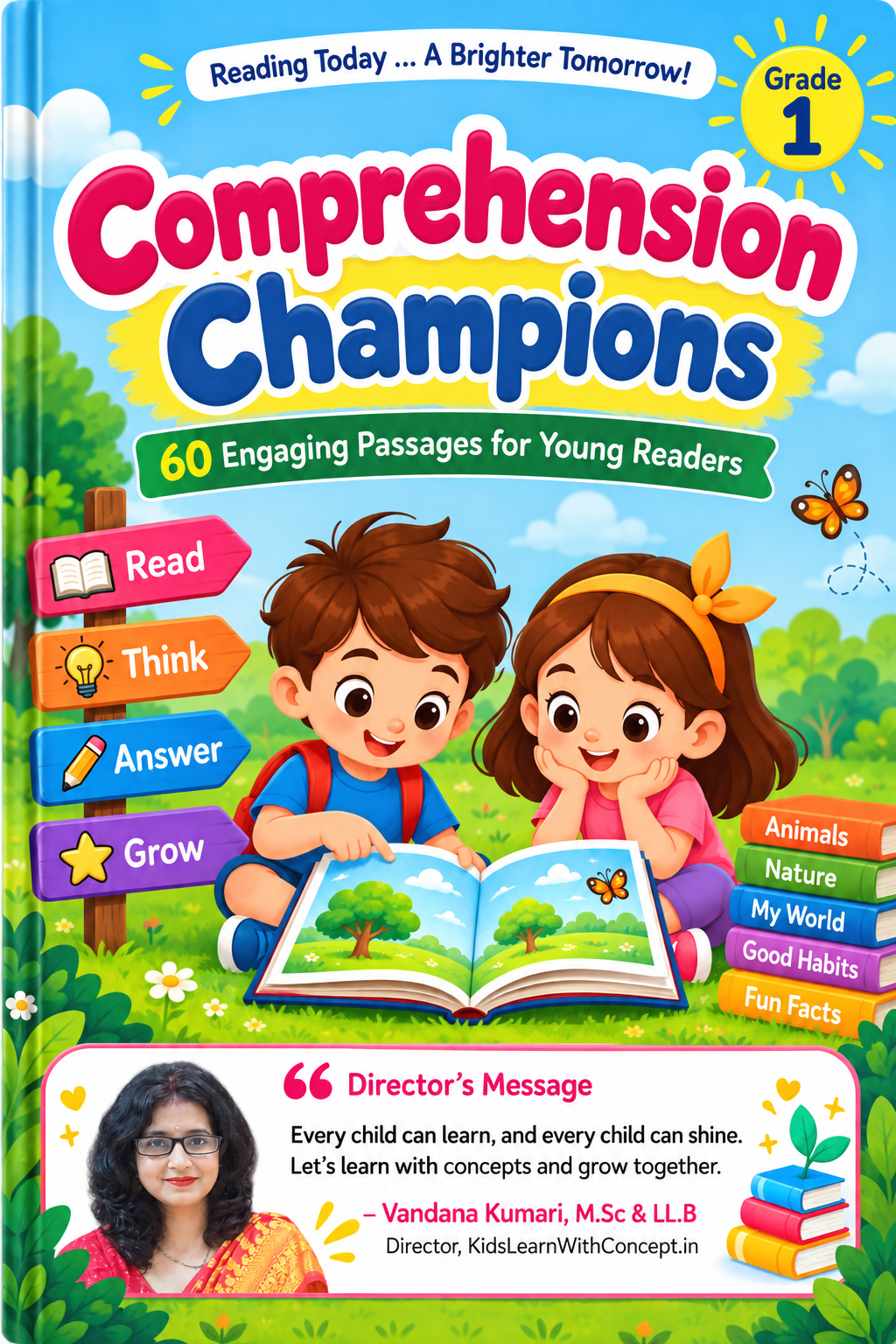
60 short reading passages for Grade 1, each on its own page with a big colour picture and its own set of questions. 📚 Five worlds a six-year-old already cares about: wild animals (elephant, monkey, bear, fox, rhinoceros, hippopotamus, crocodile, deer, tortoise), pets and farm animals (cow, dog, cat, camel, buffalo, goat, rat, rabbit, ass, sheep, ox, horse), birds and insects (peacock, owl, cuckoo, parrot, pigeon, crow, duck, hen, sparrow, housefly, mosquito, butterfly, spider, snake, lizard), the world around us (zoo, park, river, sun, moon, stars, rainbow, temple, auto-rickshaw, train, ice cream seller) and my own world (our school, school bus, school bag, school uniform, playground, my bicycle, my study room, my toys, my computer). \u270F\uFE0F Every passage is followed by real practice, not one lazy question: multiple-choice, fill in the blanks, True or False, short answers in the child's own words, and on several pages a Draw and colour box. That mix is deliberate — a child who can tick the right box has not always understood the sentence, and the short-answer lines are where you find out. 🔑 A complete Answer Key for all 60 passages is at the back (pages 65–67), checked question by question, so a grown-up can mark the work in a minute without re-reading every passage. \U0001F469\u200D\U0001F3EB Created by educator Vandana Kumari (M.Sc, LL.B) using the KidsLearnWithConcept approach. Download once, print & practise again and again! 🌟
₹149 (incl. 5% GST)
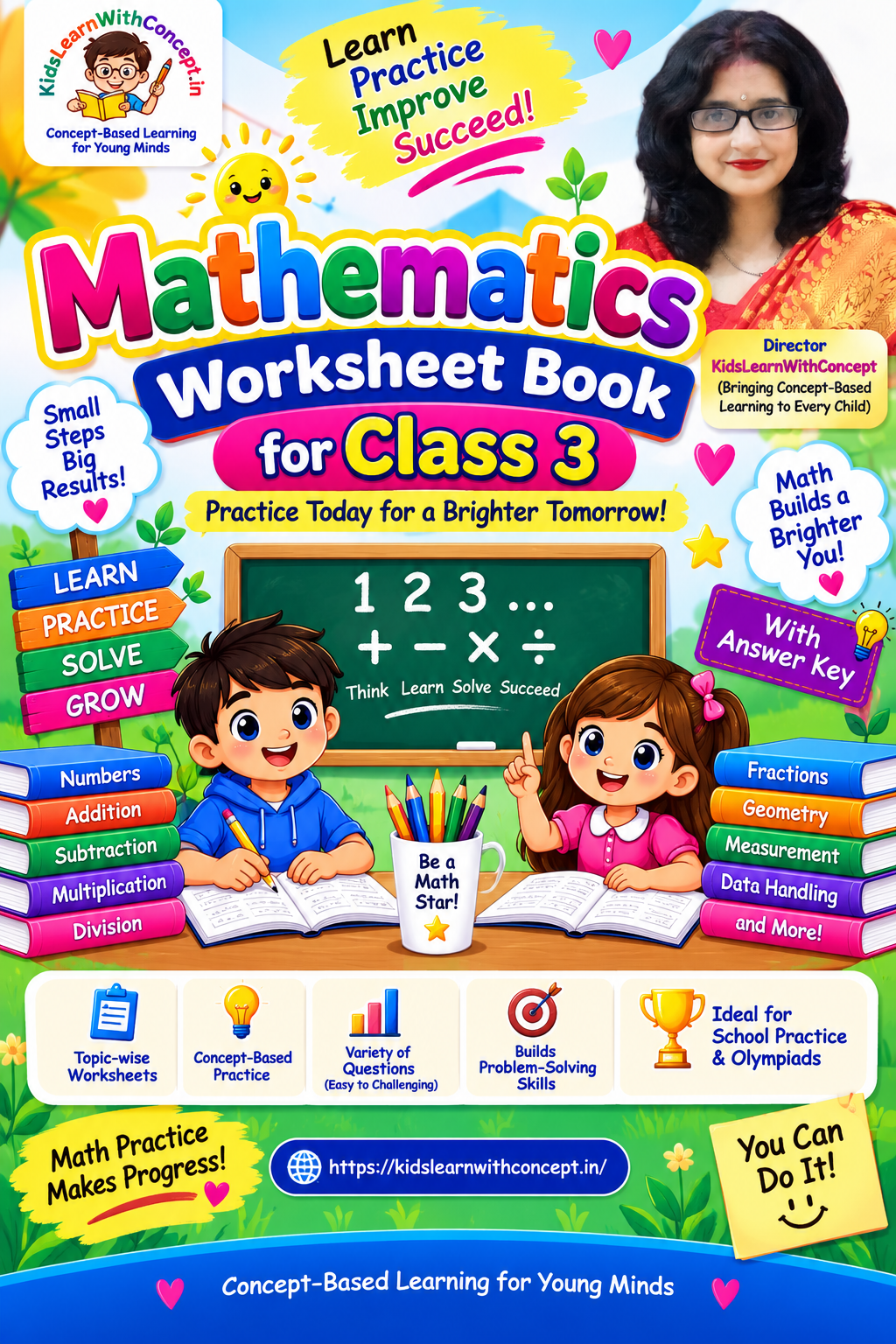
45 pages of topic-wise maths practice for Class 3, in the order the school year actually teaches them. 📘 Fourteen topics: number system, addition, subtraction, multiplication, division, fractions, length, weight, capacity, time, money, geometry, data handling, and a closing Higher Order Thinking Skills (HOTS) set of word problems and logical reasoning. ✏️ Questions run from easy to challenging — multiple-choice sets, missing-number and pattern puzzles, tally charts and pictographs to read, and real-life word problems about shopping, journeys and sharing. 🔑 Every topic has its own Answer Key at the back, and the keys are not bare: they carry step-by-step solutions and explanations, so a grown-up can show the working and not just the result. 🏅 Ideal for everyday school practice and as a gentle run-up to Olympiad papers. 👩🏫 Created by educator Vandana Kumari (M.Sc, LL.B) using the KidsLearnWithConcept approach. Download once, print & practise again and again! 🌟

₹99 (incl. 5% GST)
70 pages packed with fun, concept-based maths practice to help young learners become confident problem-solvers! Covering number sense, mathematical operations, patterns & sequences, measurement, time & money, data handling, geometry, word problems and logical reasoning, with engaging practice throughout and a complete answer key for parents.
₹149 (incl. 5% GST)
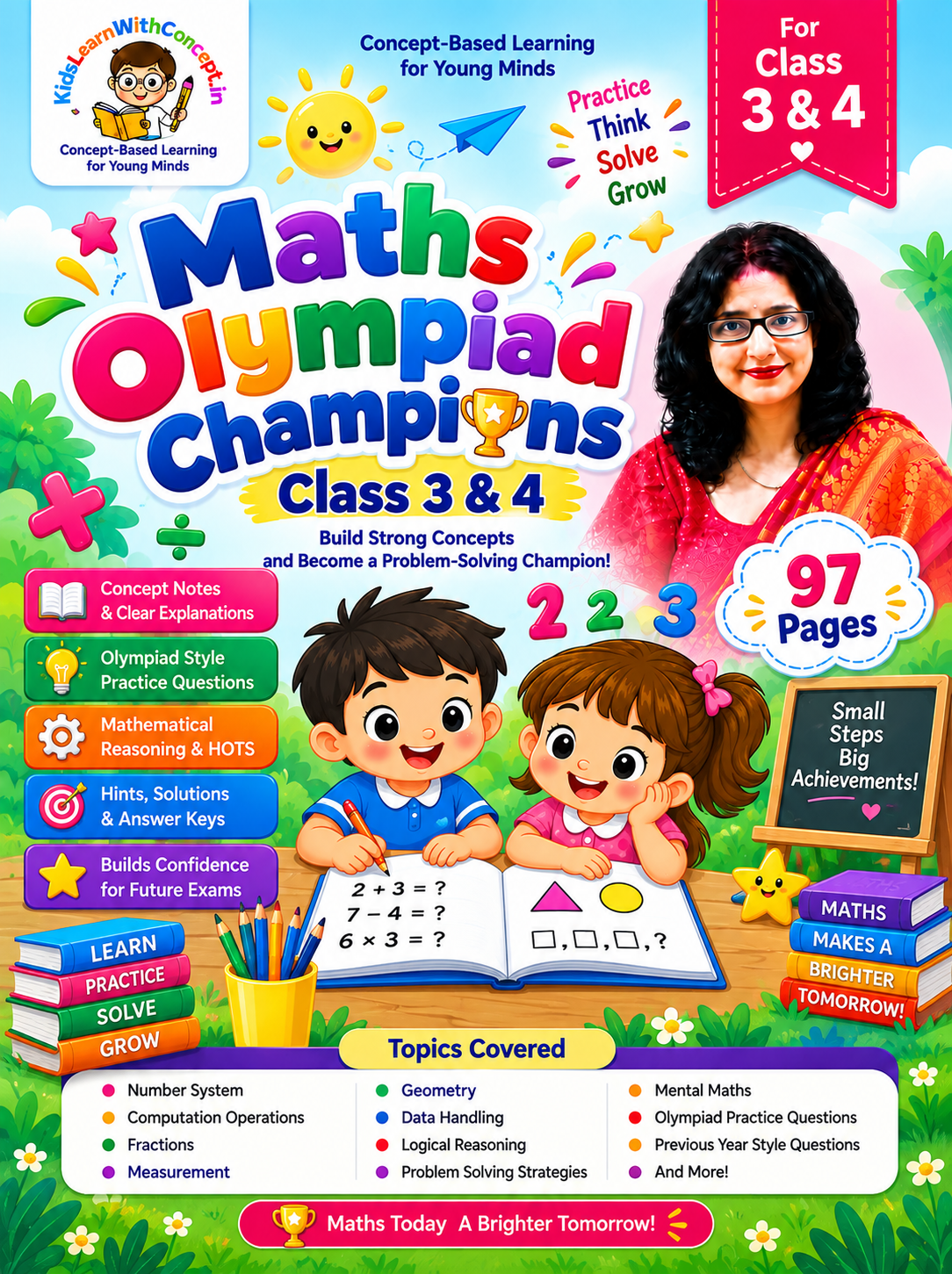
97 pages that carry Class 3 and Class 4 from the concept straight to the Olympiad question. 📘 Every chapter opens with clear learning objectives and colour-coded concept notes — number system and place value, computation operations, fractions, measurement, geometry, data handling, logical reasoning, mental maths and problem-solving strategies — and then moves into Olympiad-style practice: multiple-choice sets, HOTS ‘Achievers’ questions and real-life word problems. 💡 No answer is left bare: every set is followed by Hints & Solutions that show the step, not just the result. 🏅 Finishes with SOF International Mathematics Olympiad style sample papers and two full Model Test Papers with answer keys. 👩🏫 Created by educator Vandana Kumari (M.Sc, LL.B). Download once, print & practise again and again! 🌟
₹499 (incl. 5% GST)
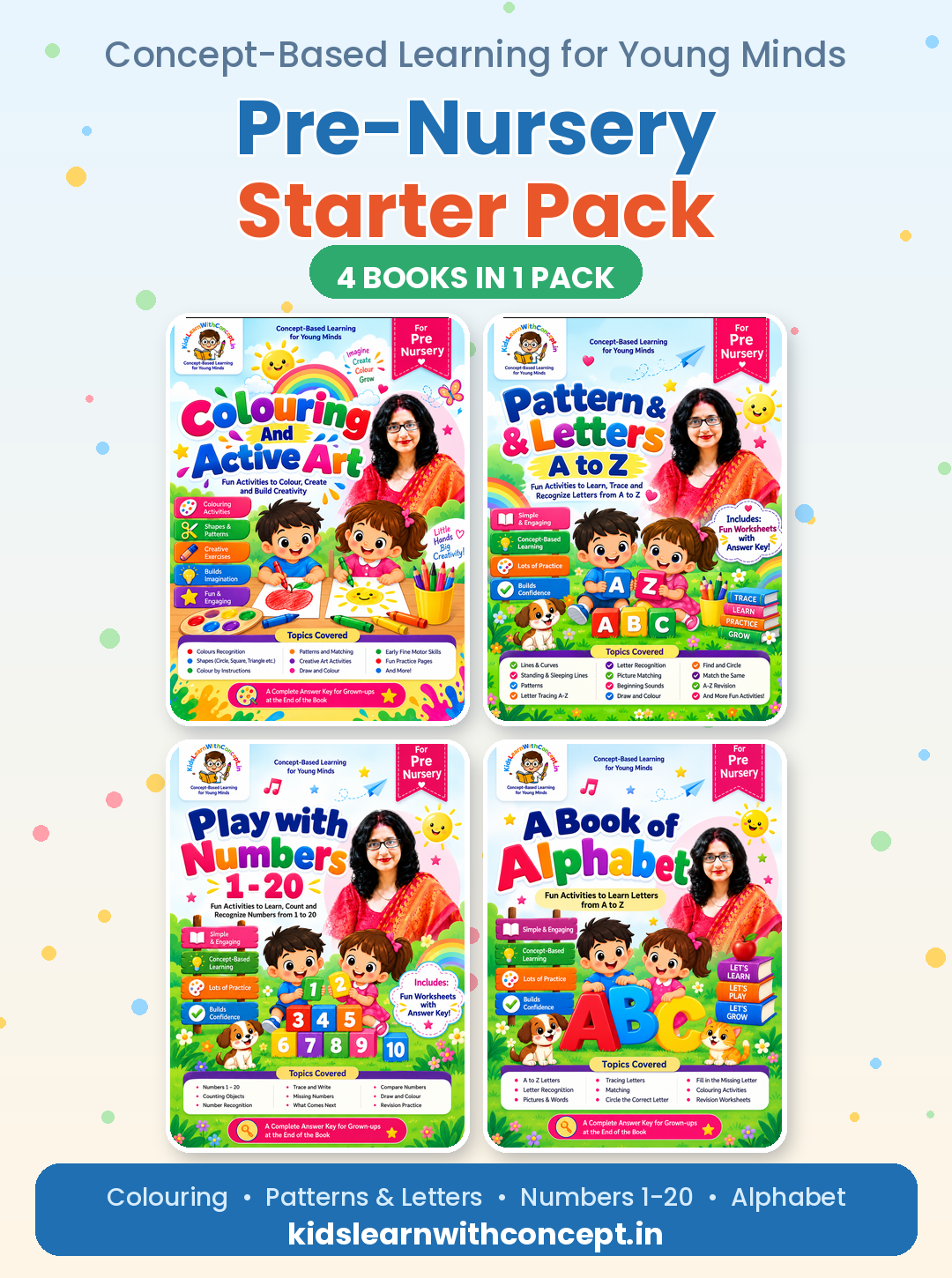
4 books included — one payment, 4 downloads:
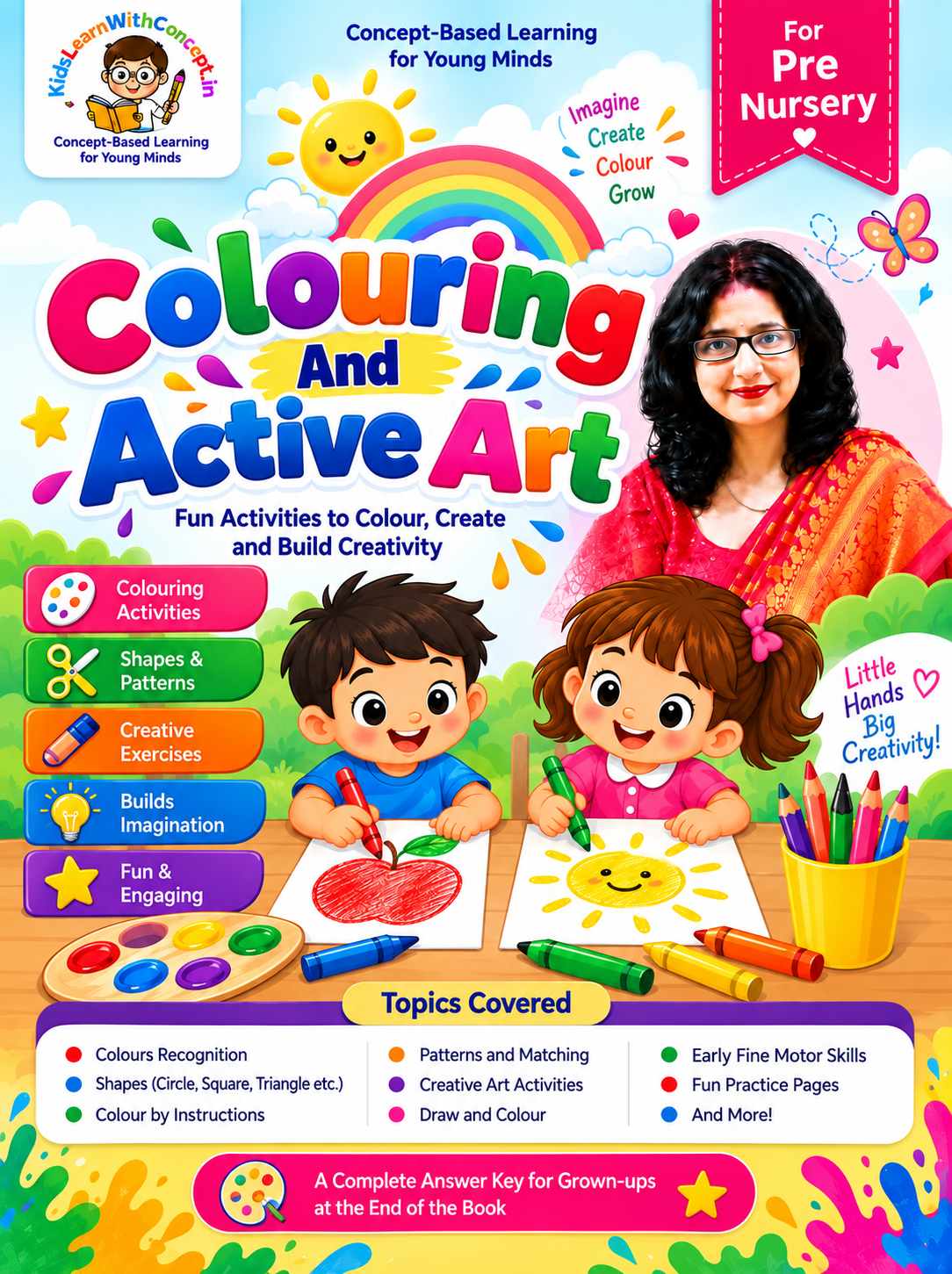
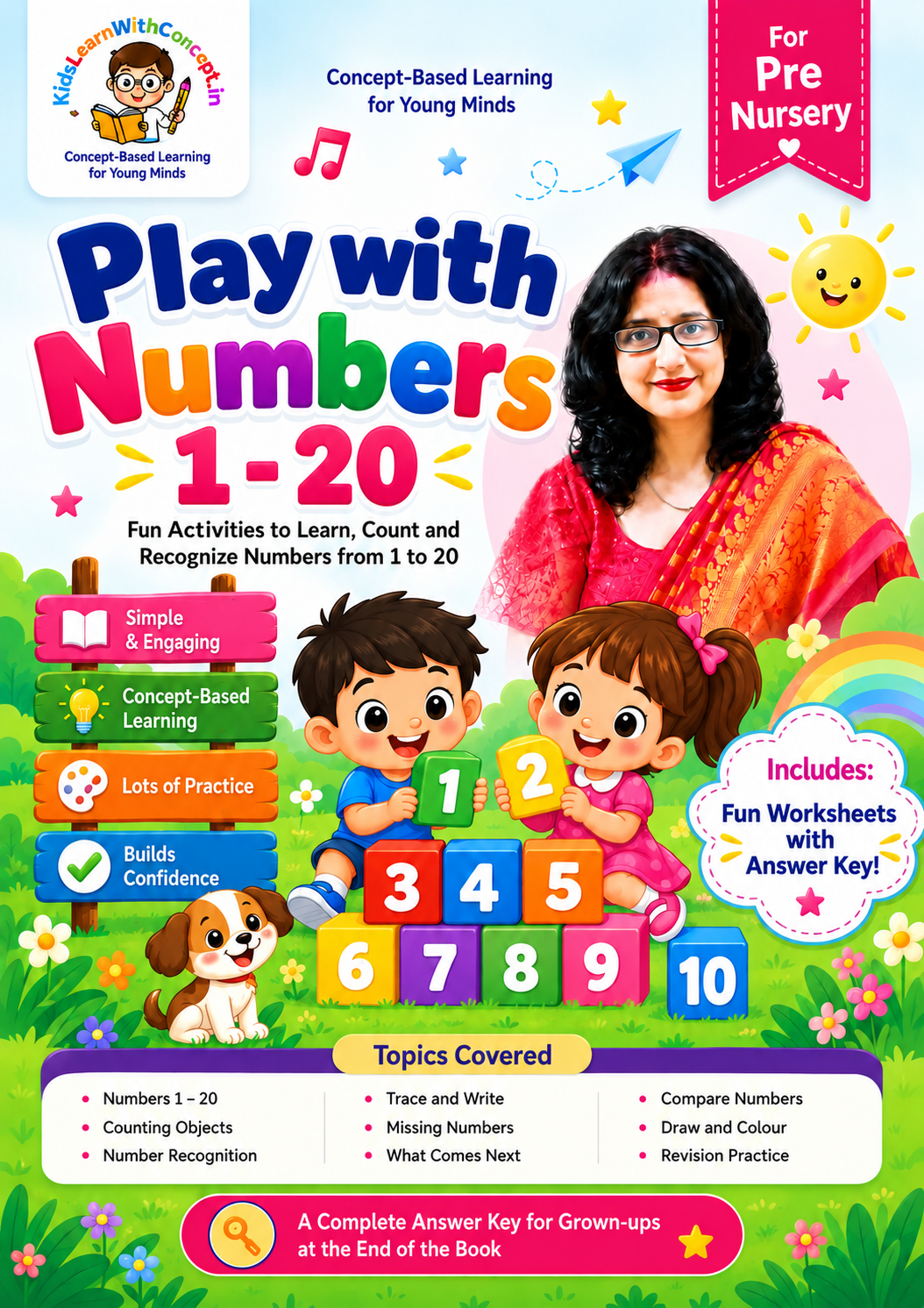
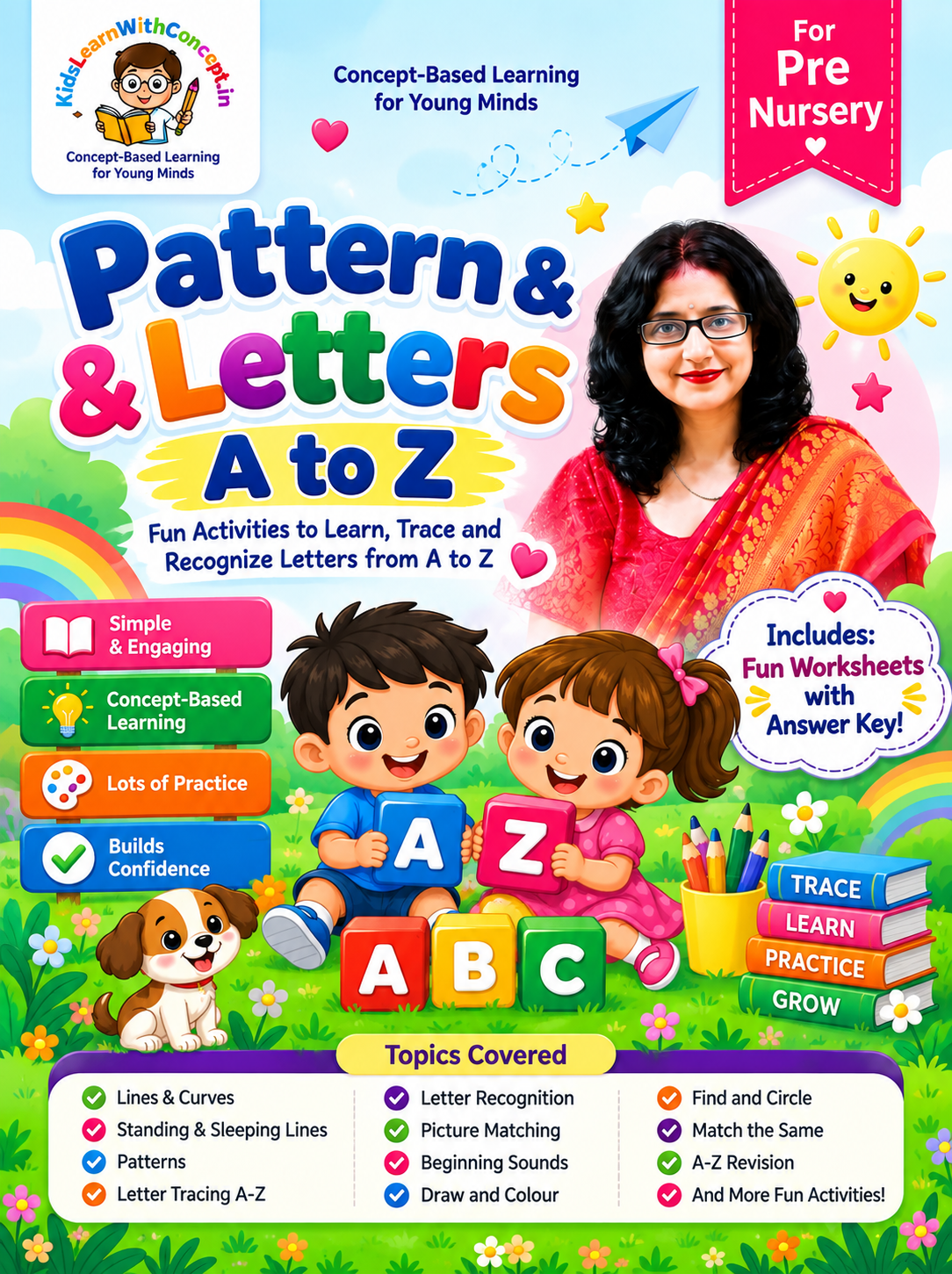
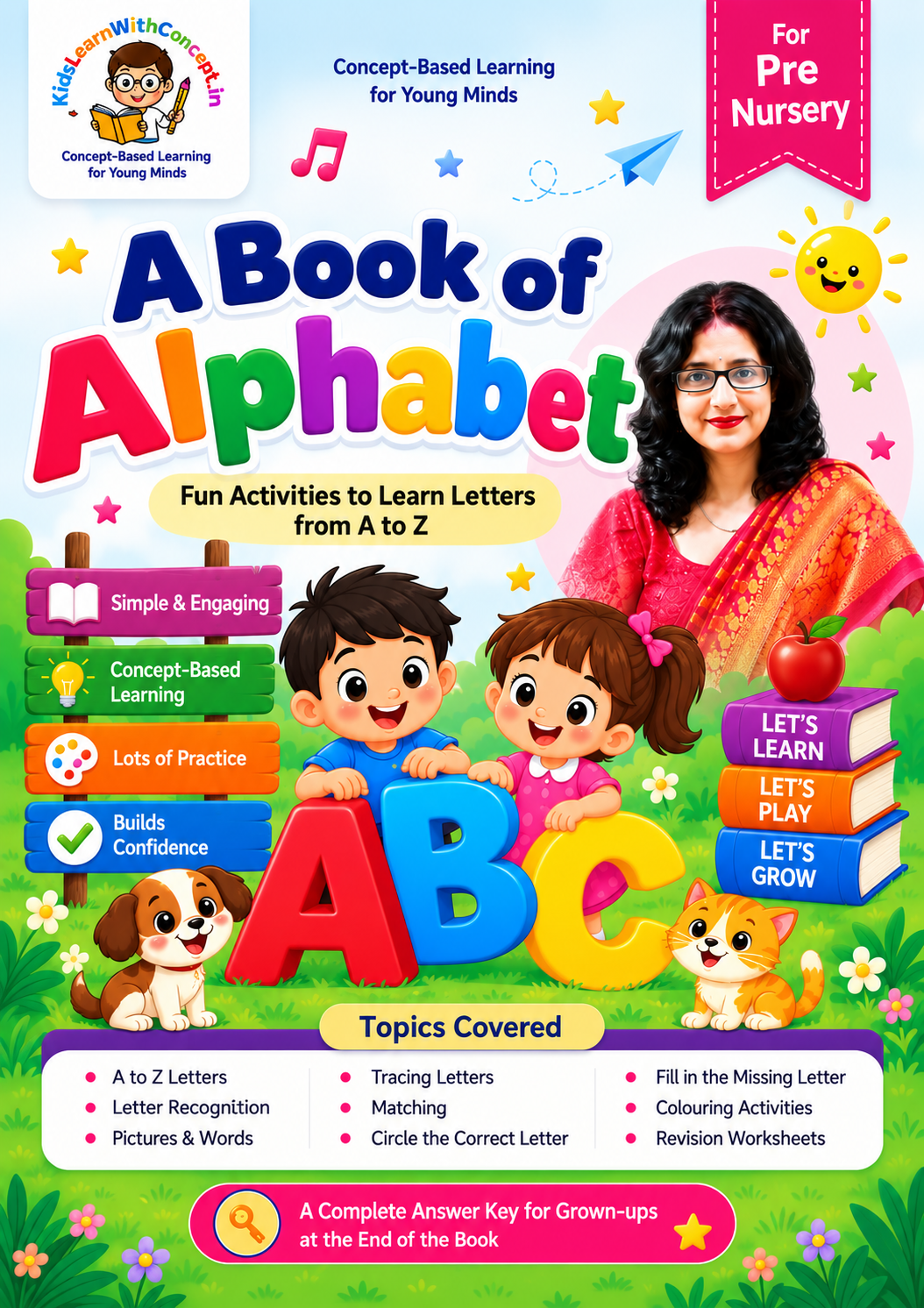
Everything a 2.5 + year-old needs for the first year of writing, in one pack of four full-colour workbooks — 153 pages in all. 🎨 Colouring And Active Art (34 pages): colour recognition, shapes — circle, square, triangle — patterns and matching, colour-by-instruction, draw-and-colour and creative activities that build early fine-motor skills. ✏️ Pattern & Letters A to Z (64 pages): standing lines, sleeping lines, curves and patterns first, then letter tracing A–Z with letter recognition, beginning sounds, picture matching, find-and-circle and a full A–Z revision. 🔢 Play with Numbers 1–20 (25 pages): counting objects, number recognition, trace and write, missing numbers, what comes next, comparing numbers and revision practice. 🔤 A Book of Alphabet (30 pages): a big bright picture for every letter — A for Apple, C for Cat, E for Elephant — each with a one-line rhyme to say aloud. 👩🏫 Written by educator Vandana Kumari (M.Sc, LL.B); every book ends with a complete answer key for grown-ups. Each book is also sold on its own for ₹149, so the pack saves you ₹97. One payment, four downloads — print and practise again and again! 🌟
₹149 (incl. 5% GST)
34 pages that teach the hand to stop at a line — the first skill every letter a child ever writes depends on. 🖍️ Colour recognition, then the three shapes that matter first (circle, square, triangle), then patterns and matching, colour-by-instruction (colour the squares red, colour the circles blue), draw-and-colour and open creative activities. ✂️ Builds early fine-motor skills and the habit of following a rule while holding a crayon. 👩🏫 By educator Vandana Kumari (M.Sc, LL.B), with a complete answer key for grown-ups at the back. Also in the Pre-Nursery Starter Pack, which is cheaper than buying the four separately. 🌟
₹149 (incl. 5% GST)
25 pages that take a child from chanting numbers to actually knowing them. 🧮 Counting objects by touching each one, recognising the numeral among others, tracing and writing it, missing numbers, what comes next, and comparing two groups — in that order, because saying “one two three” is not the same as handing you three buttons. 🎯 One to ten first and properly, then eleven to twenty. 👩🏫 By educator Vandana Kumari (M.Sc, LL.B), with a complete answer key. Also in the Pre-Nursery Starter Pack. 🌟
₹149 (incl. 5% GST)
64 pages — the biggest book of the four, and the one that does the most work. 📐 Patterns first: standing lines, sleeping lines, slanting lines and curves, traced row after row with a picture to colour at the top of every page. Those four strokes are what every capital letter is made of, so a child who can trace them is practising six letters at once without knowing it. 🔤 Then letters A to Z: tracing, letter recognition (find every I among L, A, M, B, V), beginning sounds, picture matching, find-and-circle, match-the-same and a full A–Z revision. 👩🏫 By educator Vandana Kumari (M.Sc, LL.B), with a complete answer key. Also in the Pre-Nursery Starter Pack. 🌟
₹149 (incl. 5% GST)
30 pages, one big bright picture for every letter of the alphabet. 🍎 A for Apple, C for Cat, E for Elephant — the capital and the small letter in the corners, the whole A–Z strip down the side of each page, and a one-line rhyme to say aloud (“C for cat, runs after the rat”). 🗣️ That rhyme is what a three-year-old still remembers a week later, which is why picture-and-sound books beat copying at this age. Letter recognition, tracing, matching and colouring activities throughout. 👩🏫 By educator Vandana Kumari (M.Sc, LL.B). Also in the Pre-Nursery Starter Pack. 🌟

₹149 (incl. 5% GST)
100 pages and 1,305 everyday English sentences, each with its Hindi meaning, across 29 practical topics — greetings, school and home, daily routine, questions, feelings and requests, shopping and travel, tenses, advanced conversation, friendships, conflicts at school and at the office, business situations, numbers and time, health and the doctor, weather and nature, phone calls and online safety, festivals and manners, emergencies, food, sports, describing people, directions, money, hobbies, jobs, classroom English and interviews. ✏️ Every topic is followed by its own practice page (fill in the blanks, match the pairs, translate and speak), and a complete answer key is at the back. Also includes 10 word banks with 480 words, 6 real conversations, 4 grammar tables, a 30-day speaking plan and a printable certificate. 👩🏫 Written by educator Vandana Kumari (M.Sc, LL.B). Download once, print & practise again and again! 🌟

₹299 (incl. 5% GST)
166 pages that carry your child from single letter sounds all the way to reading full sentences! 15 easy concept-first steps, each with 5+ colourful worksheets, plus a complete answer key for parents. 👩🏫 Created by educator Vandana Kumari (M.Sc, LL.B) for UKG–Class 2. Download once, print & practise again and again — the confident little reader you've been hoping for starts here! 🌟

₹199 (incl. 5% GST)
199 pages in two parts, so your child can learn from pictures first and then practise step by step. 🖼️ Part 1 — Picture Lessons brings fifteen full-colour illustrated lessons, hand-drawn by the author: naming words, one and more than one, he and she, describing words, a / an / the, this / these / that / those, I / you / he / she / it, doing words, is / are / am and am + ing, has / have / had, was / were, talking about the past, joining words, alphabetical order and composition — every lesson sheet reproduced in full, followed by a clear recap page and its own worksheets. 📘 Part 2 — Grammar Step by Step is the complete 15-chapter course: naming words, special names, one & many, gender, pronouns, a/an, this/that/these/those, action words, describing words, opposites, prepositions, is/am/are, has/have, was/were and punctuation, each with simple explanations, clear examples and colourful practice. 👩🏫 Created by educator Vandana Kumari (M.Sc, LL.B) using the KidsLearnWithConcept approach. 🌟 A complete Answer Key for grown-ups covers both parts.

₹183.75 (incl. 5% GST)
A fun, concept-based workbook that makes English grammar, writing, and composition easy and enjoyable! With 15 carefully structured chapters, children learn The Alphabet, A/An/The, Naming Words, One and Many, I/You/He/She/It, Describing Words, Action Words, Is/Am/Are, Has/Have, Position Words, Sentences, Joining Words, Fun with Words, Composition, and Story Writing through simple explanations, clear examples, and plenty of engaging practice activities. ✏️ Includes Test Papers, Listening for the Teacher, Composition and Story Writing activities, and a complete Answer Key for grown-ups.

₹5.25 (incl. 5% GST)
Playful, concept-based grammar for early readers! Teaches the simple rules of has, have, and had using vibrant visuals, sentence building, and engaging exercises. 🖍️ Instant download — print and reuse endlessly for stress-free English practice! 🌟
₹155 (incl. 5% GST)
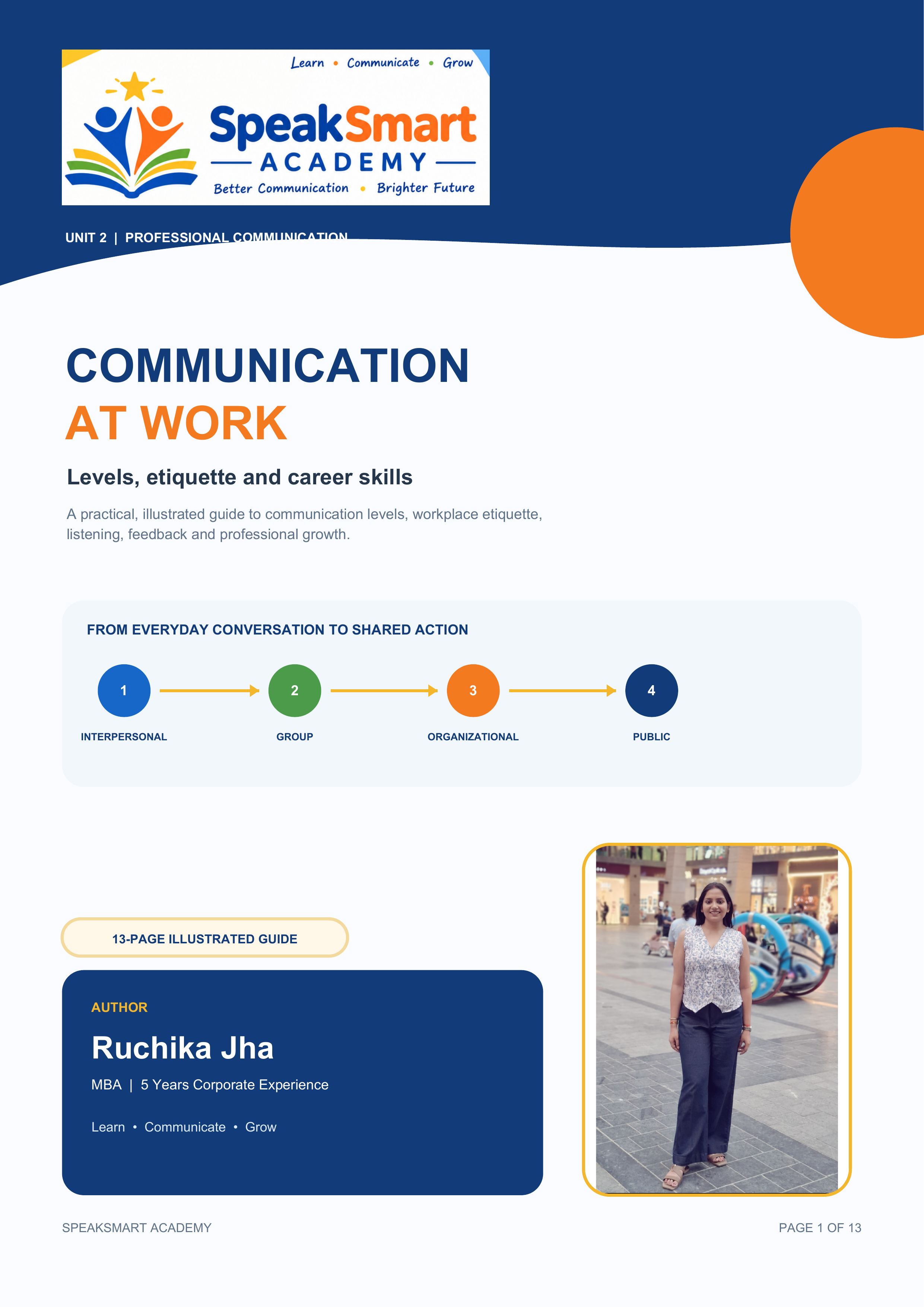
A practical guide to communication levels, workplace etiquette, cross-cultural understanding, negotiation, career skills, active listening, feedback and professional digital presence.
₹205 (incl. 5% GST)
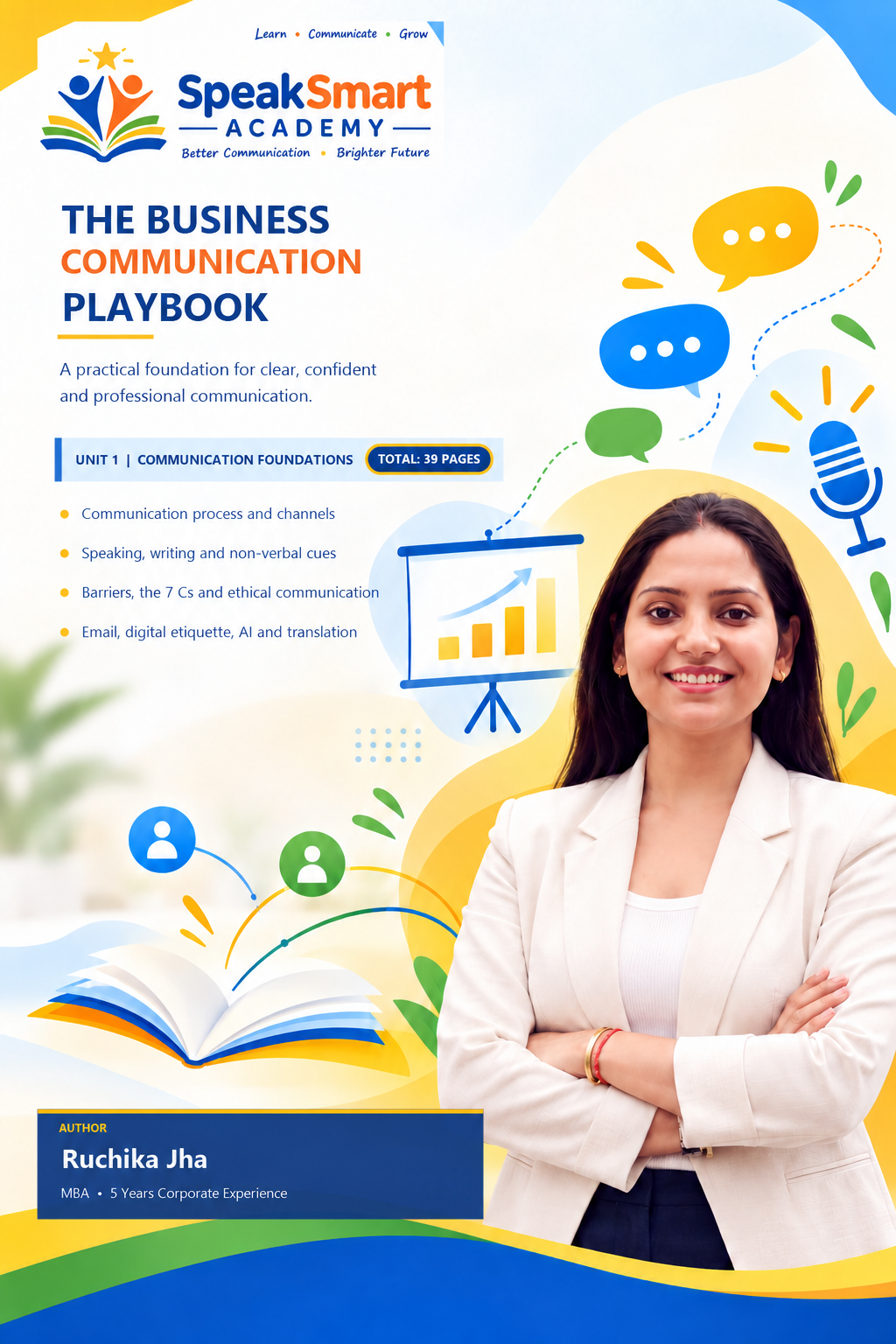
A practical, 39-page introduction to business communication, organized for quick learning and reference. It covers: - The meaning and process of business communication - Oral, written and non-verbal communication - Common communication barriers - The 7 Cs of effective communication - Ethics, privacy and confidentiality - Email, digital and virtual-meeting etiquette - How AI, NLP and real-time translation support modern communication - A concise summary of key takeaways The book also includes a contents index and page numbers for easy navigation.
It is 33 printable Grade 1 maths worksheets. Sixteen are addition and subtraction set out in tens-and-ones (T and O) columns, each with picture word problems about baskets, boxes, marbles and crayons. The other seventeen are place value: draw the beads on the abacus and write tens and ones, write number names, put numbers in ascending and descending order, and compare with greater than, less than and equal to. Four of the worksheets are free to download from the Worksheets section. The book is Rs. 30 including GST instead of the Rs. 50 list price.
It has 60 short reading passages for Grade 1, one to a page with a big colour picture. Each passage is followed by multiple-choice questions, fill in the blanks, True or False and short answers in the child's own words, and several pages add a Draw and colour box. A complete answer key for all 60 passages is at the back on pages 65 to 67. It is 67 pages, and the launch offer is Rs. 149 including GST instead of the Rs. 200 list price.
Delivery is instant. As soon as your payment succeeds the PDF opens for download, and it stays available on the same device and browser for 7 days — so please save the file to your device.
The material covers Pre-Nursery through Class 12. Each e-book lists its own level: the Pre-Nursery Starter Pack is for ages 3 to 5, Reading Steps is for UKG to Class 2, the Grammar workbooks are for Class 1, and Maths Olympiad Champions comes in two levels - Class 1 and 2, and Class 3 and 4.
Four printable workbooks for one price: Colouring And Active Art, Pattern and Letters A to Z, Play with Numbers 1 to 20, and A Book of Alphabet - 153 pages in all, each with an answer key for grown-ups. One payment gives you a download page with all four books, and the same link is emailed to you.
Yes. Each of the four Pre-Nursery titles is also sold on its own for Rs. 149 including GST - Colouring And Active Art, Play with Numbers 1 to 20, Pattern and Letters A to Z, and A Book of Alphabet. The pack costs Rs. 499 for all four, so it saves Rs. 97 if you want the whole set.
Yes. Everything is a printable PDF. Download once, then print at home as many times as you like for your own child — ideal for daily practice and revision.
Payments are handled by Razorpay, so UPI, cards, net banking and wallets are all supported and your card details never touch this website. Every price shown on a book card already includes 5% GST.
No. Because the books are digital and delivered instantly, all sales are final. If you hit a genuine technical problem — the file will not open, the download fails, or you received the wrong file — contact us within 48 hours with your payment reference and we will fix your access.
Yes. The Worksheets, Notes and Samples section has free printable worksheets and presentations covering phonics, long vowels, nouns, pronouns, prepositions and maths for Class 1 to Class 5, Navodaya Vidyalaya Class 9 entrance papers, plus free learning videos.
They are written by Vandana Kumari (M.Sc, LL.B), a practising educator, using the Kids Learn With Concept approach: teach the concept first, then practise it. Every paid workbook includes a complete answer key for parents.
Free reference guides written by educator Vandana Kumari. Open one below, or read it full-screen on its own page.
A gentle, practical plan to help children aged 10–14 shift from holiday sleep patterns to school mornings while protecting adequate sleep and involving the child in the routine.
A practical, non-shaming plan to help children aged 10–14 build steadier routines, practice self-study, speak respectfully and take greater ownership of their time—with parents acting as calm, consistent guides.
Why word-by-word translation produces nonsense, the four things that change between Hindi and English, the three-step method that works, and why the pronunciation line matters more than the meaning.
Why a child who can add perfectly still stares at a word problem, the key words that signal add or take away, the read-find-draw-solve routine, and how to tell a reading problem from a maths one.
The question most books skip - when you compare two numbers, should you subtract or divide? Plus the terms of a ratio, how a ratio differs from a fraction, dividing in a given ratio, and proportion.
Where the commas go in each system, why mixing them quietly breaks every large-number question, face value against place value, forming the greatest and smallest numbers, and expanded form.
Why four sentences is the right number and not a soft option, the four questions that turn any picture into four lines, what helping words are really for, the five mistakes grown-ups make when marking, and a fifteen-minute routine.
Why asking for ten sentences just gets the same four written twice, the line-by-line order that fills a paragraph without repeating, the one sentence that separates describing from composing, and a five-point marking scheme.
Why letters come after lines: colouring and shapes first, then standing, sleeping and slanting lines, then A to Z in four passes, then numbers 1 to 20 - with a 15-minute daily routine that a three-year-old will actually sit through.
What an olympiad paper really asks, the syllabus chapter by chapter with a sample question for each, why the Achievers section decides the rank, a six-week plan and the three-attempt rule for using worked solutions.
Why a Class 1 olympiad is a thinking paper and not an arithmetic race, the eleven kinds of reasoning question with an example of each, a four-week fifteen-minute start, and whether a six-year-old should sit the exam at all.
The fifteen chapters of Class 1 English in the order a child should meet them - the alphabet, a/an/the, one and many, is/am/are, has/have, sentences, joining words - and how joining words bridge grammar into composition.
Has for one, have for more than one and for I, you, we and they, had for everything in the past. The four mistakes children make, what to say back each time, and a five-minute game that fixes it.
How every vowel is actually pronounced, rule by rule, with the Hindi reading beside each example word — from short "a" in cat to the long sounds in cake, ball and park.
Why the b in comb, the k in knee and the h in hour stay silent. Every letter of the alphabet, the rule behind it, and example words with Hindi readings.
A full phonics-to-comprehension guide: phonic sounds, vowels and consonants, CV, VC, CVC and CCVC words, blends, digraphs, silent letters and syllables.
Why reading English does not make you speak it, a 15-minute daily routine, 50 everyday sentences with Hindi meanings, and the five mistakes that keep learners silent.
Names of persons, places, animals and things — plus special names and common names, and why Sana takes a capital letter but girl does not. With picture practice and a full answer key.
How one small letter changes everything: adding –s to a naming word to show more than one. Count the pictures, choose the right word, and check with the answer key.
When to use he and when to use she, sorting family words into two columns, and the male and female names for animals — lion and lioness, horse and mare, drake and duck.
Big house, small cat, square box, blue bird. The words that tell us more about naming words, with matching, fill-in-the-blanks and a naming-word-or-describing-word test.
Vowels and consonants first, then the rule that never changes: a before a consonant sound, an before a vowel sound, and the for something we already know about.
The four pointing words: this and these for what is near us, that and those for what is far — and why this takes is while these takes are.
Growing up with Artificial Intelligence, smart agents and friends from every culture — here is a little spark of guidance for every stage, from tiny tots to teens. 🤝 🌍 🤖
Curiosity is your very first superpower. Touch, taste, ask “why?” about everything — even the cleverest AI began by being curious, just like you!
Read more →Say “hello” in many languages and share your crayons with everyone. The world is one big playground of friends from every country and culture.
Read more →Read a little every day. Words are the magic tools you’ll use to talk to people — and one day to guide smart machines too.
Read more →Ask questions no computer can answer — about feelings, fairness and dreams. Your kind heart and imagination are gifts AI can never copy.
Read more →Use AI as a helper, not a shortcut. Let it explain, but do the thinking yourself — your brain only grows stronger when you actually use it.
Read more →Go deep in one passion and stay curious about many. In an AI world, people who are curious, adaptable and honest shine the brightest.
Read more →Learn to lead AI agents — direct them, question them, and always verify their answers. The future belongs to those who guide the machines with wisdom, and who respect every culture and belief.
Read more →Be kind online and offline, celebrate every language and tradition, guard your privacy, and never forget: technology is only a tool — your character and values are what truly make you unstoppable.
Read more →
Connect With Us
Have a question, feedback, or a book request? Send us a message — we'd love to hear from you! 💬