 Kids Learn With Concept
Ask a child to translate मुझे भूख लगी है and you will often get “me hunger felt is”. Every word is correctly translated. The sentence is wrong. This is the single biggest obstacle for a child learning English in a Hindi-speaking home, and it is not a vocabulary problem — it is a word order problem. No amount of learning more words fixes it. This guide is about what actually does.
The four things that change between Hindi and English
Hindi puts the verb last. English puts it in the middle. Almost every mistake starts there.
| What changes | Hindi | English |
|---|---|---|
| Word order | Subject – Object – Verb मैं खाना खाता हूँ | Subject – Verb – Object I eat food |
| Postposition vs preposition | The word comes after: मेज पर | It comes before: on the table |
| Articles | No a, an or the | Needed nearly everywhere: a gust, the road |
| Helping verbs | Often one word: रहा था | Two or three: was returning, had been walking |
A child who knows these four exist will stop translating word by word, because they can see that the words are not going to line up. That realisation is the lesson. Everything after it is practice.
Translate the meaning, not the words
The method that works is three steps, and it is worth saying them out loud the first few times:
| Step | What to do |
|---|---|
| 1 | Read the whole Hindi sentence and say what is happening. Not in English — in your own words. “Someone was coming home and the wind blew hard.” |
| 2 | Find who is doing what. That is your subject and verb, and in English they go first and second. |
| 3 | Then add the rest — where, when, how. |
The line most books leave out
A child who cannot say a word will not use it, however well they understand it.
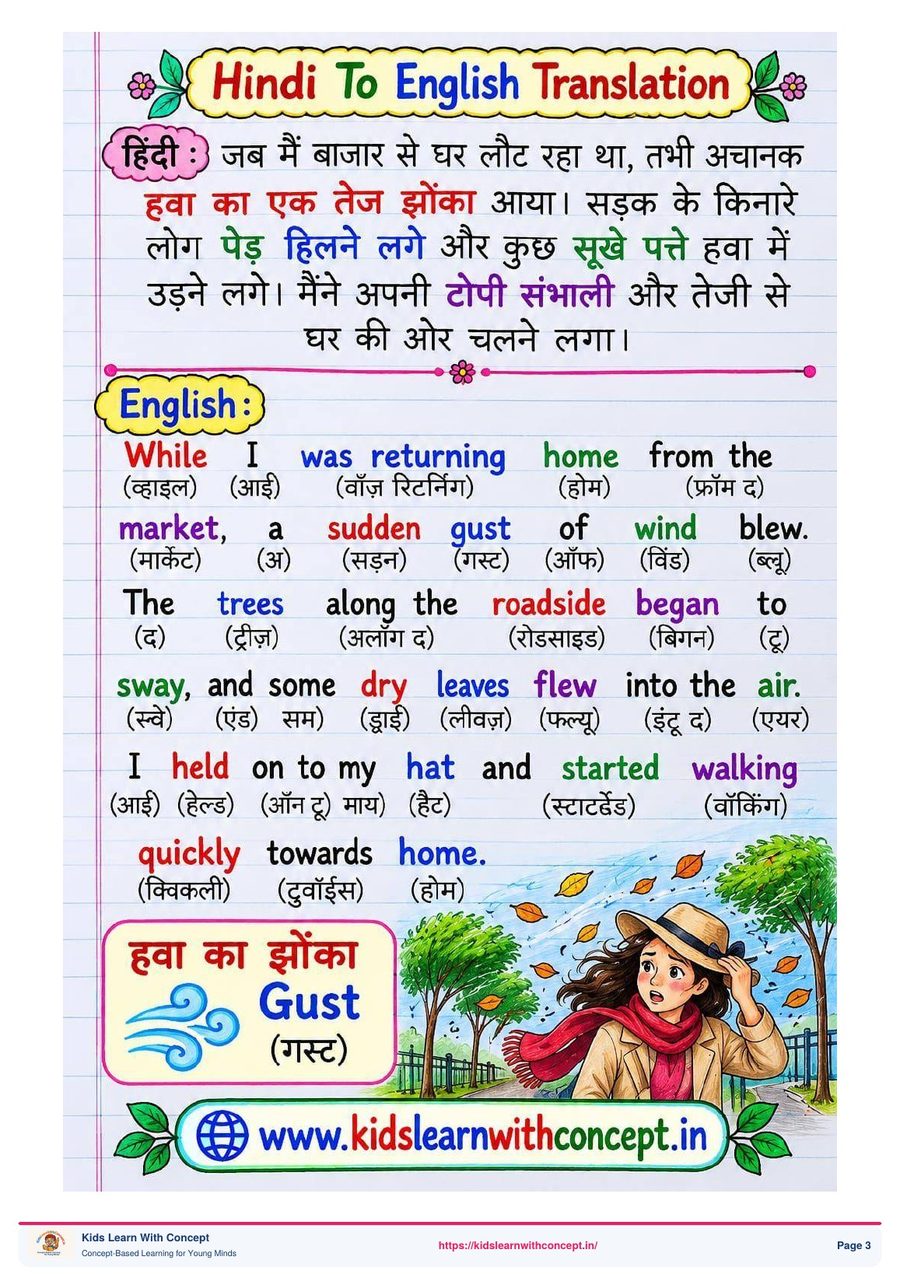
Look at the page above again. Under every English word there is a third line in Devanagari: returning has रिटर्निंग under it, roadside has रोडसाइड. This is the part that most translation books skip, and it is the part that decides whether the word ever gets spoken.
A child reading silently can get by on recognition. The moment they have to say the sentence aloud — in class, to a parent, in an exam viva — a word they cannot pronounce is a word they will swap for a simpler one. Printing the sound removes that problem at the moment the word is learnt, rather than leaving the child to guess and be corrected later.
Use passages, not sentences
Isolated sentences teach grammar. Passages teach translation, because the second sentence has to agree with the first: the same tense, the same person, the same subject carried forward. A child who translates five unrelated sentences correctly can still produce a paragraph that changes tense halfway through.
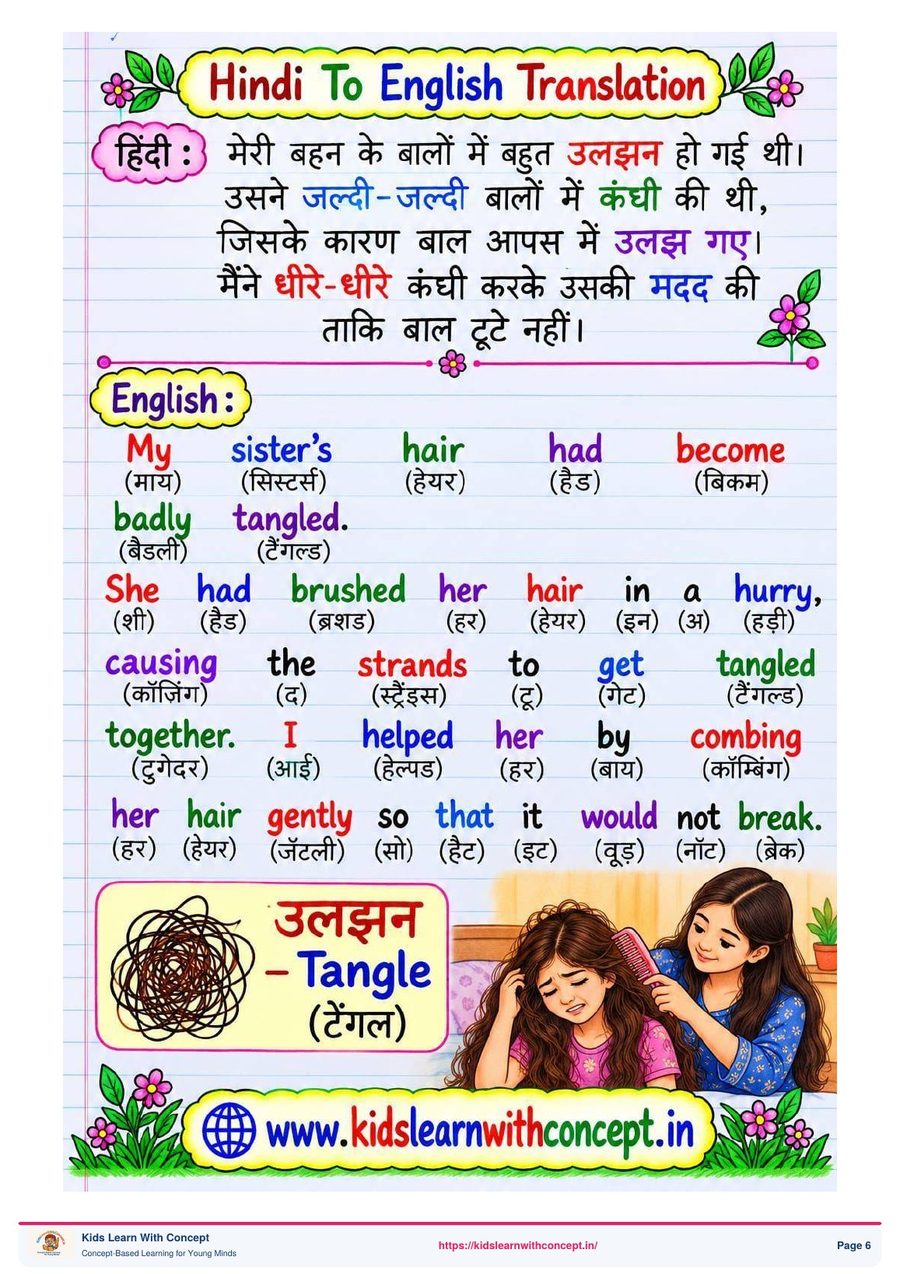
The passages worth using are the ones a child could have lived through that week. Not the farmer went to the market, but a gust of wind on the way home, hair that will not comb, a pothole, a phone battery dying, the milkman, a crack in the wall. A child who has stood in the situation already has the Hindi fluent in their head; the only new thing is the English.
One word per page, properly
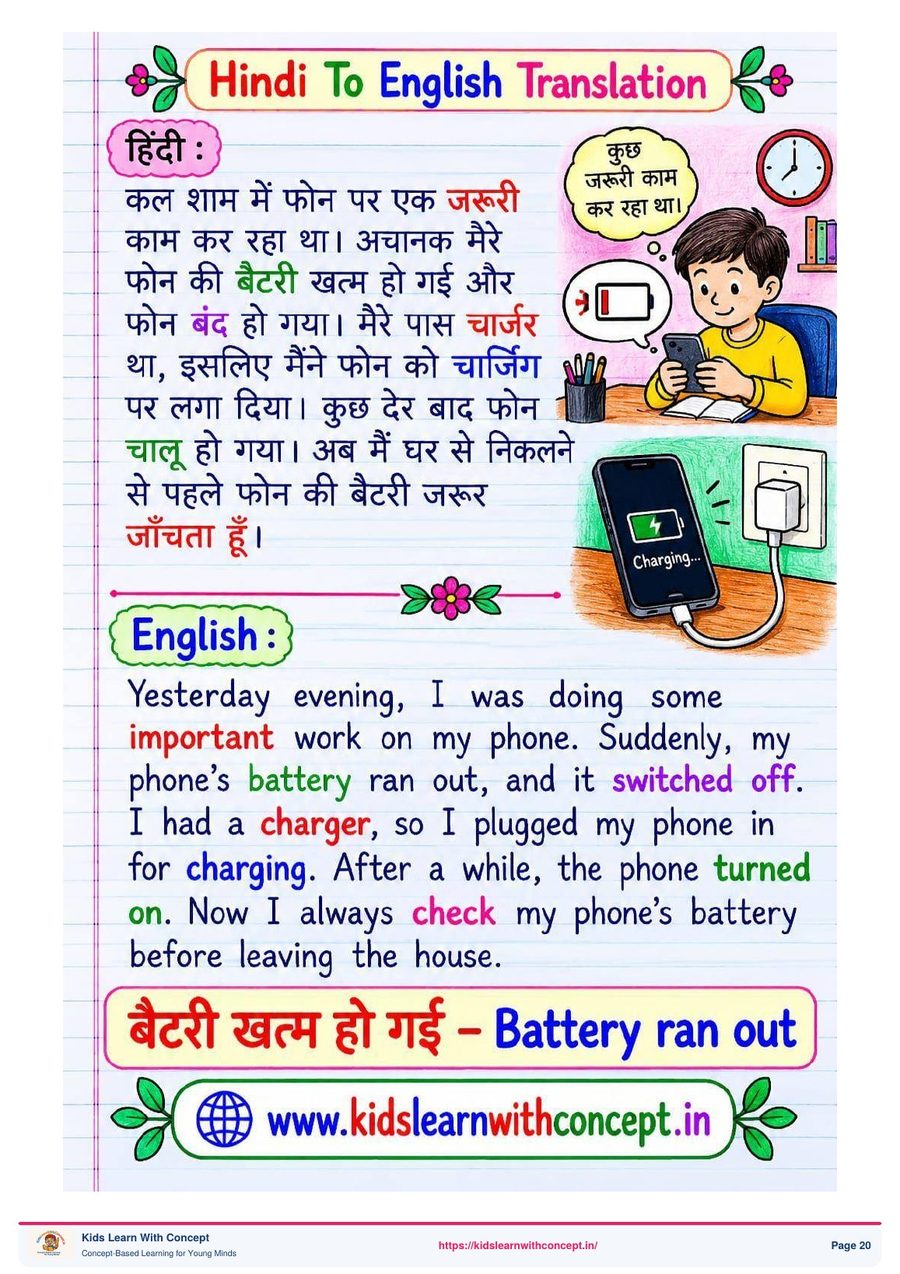
Each passage is built around one word a child is unlikely to know: gust, crop residue, pothole, tangle, battery ran out. That word gets a box at the foot of the page with its Hindi meaning and a picture. Twenty passages, twenty words — which does not sound like many until you notice they are words a child will actually reach for, rather than twenty words from a list.
What to correct, and what to leave
| Correct it | Leave it |
|---|---|
| Verb in the wrong place — this is the whole skill | A different but correct word choice (strong wind for gust) |
| A missing a, an or the | A shorter sentence than the model, if it is correct |
| Tense changing halfway through a passage | Spelling, until the sentence itself is right |
| Postposition left after the noun (table on) | Hindi word order in speech — fix it in writing first |
Try two passages free. Two pages from this book are in the free Worksheets section, under Translation (Hindi to English) — A Gust of Wind and Buying Vegetables.
How much, how often
One passage, twice a week. A passage takes about fifteen minutes done properly: read the Hindi, say what happens, write the English, then read the model and compare. Twenty passages at that rate is a school term, and a term is about how long it takes for “me hunger felt is” to stop appearing.