 Kids Learn With Concept
Most Class 6 children can simplify 18 : 24 to 3 : 4 long before they can say what a ratio is for. They have learnt a procedure, and the procedure survives exactly until the question is worded differently. The fix is not more practice. It is one question, asked before any notation appears: when you compare two numbers, should you subtract or divide?
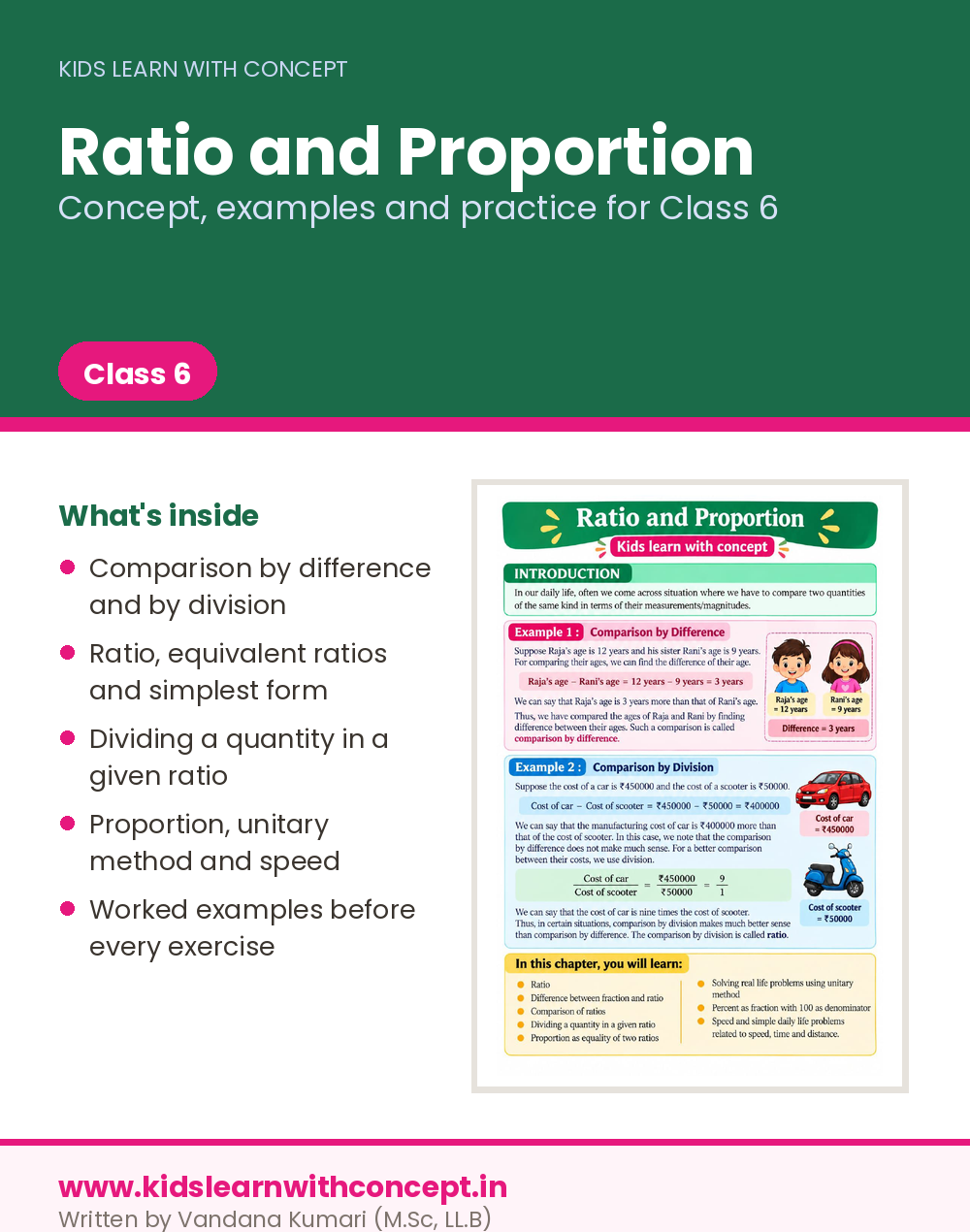
Two ways to compare, and when each one is useless
Subtraction tells you how much more. Division tells you how many times. They are not interchangeable.
| Compare | By subtracting | By dividing | Which is useful? |
|---|---|---|---|
| Raja is 12, Rani is 9 | Raja is 3 years older | Raja is 1.33 times as old | Subtracting. “3 years older” is how people actually think about age. |
| Car ₹4,50,000, scooter ₹50,000 | The car costs ₹4,00,000 more | The car costs 9 times as much | Dividing. “Four lakh more” tells you almost nothing without knowing the scooter's price. |
That second row is the whole chapter in one line. Once a child sees that there are comparisons where subtraction is genuinely the wrong tool, ratio stops being a notation to memorise and becomes the answer to a question they can now feel.
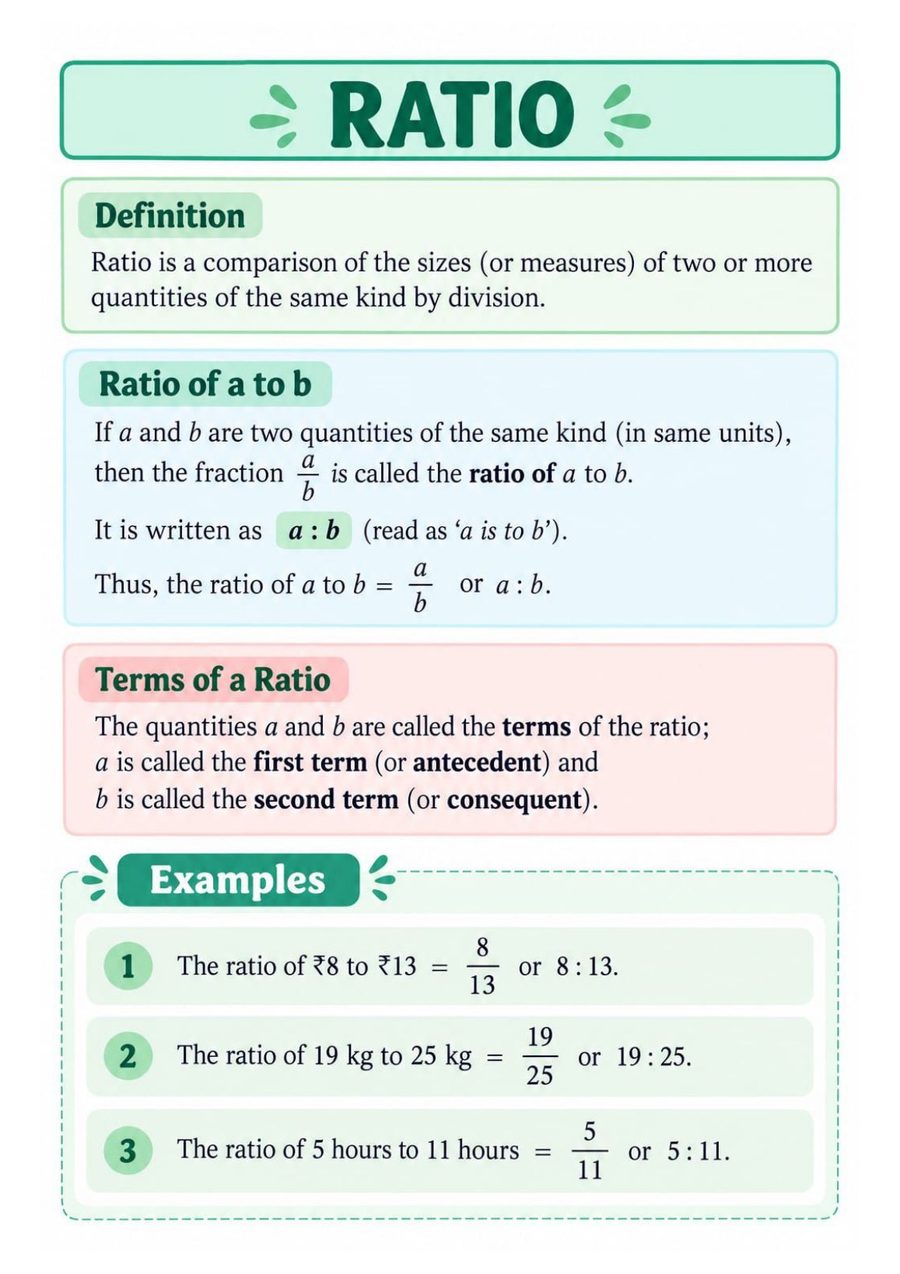
The vocabulary, which is small and worth being strict about
| Term | Means |
|---|---|
| a : b | Read “a is to b”. The same as the fraction a/b. |
| Terms | The two quantities, a and b. |
| Antecedent | The first term, a. (Latin: the one that goes before.) |
| Consequent | The second term, b. (The one that follows.) |
| Simplest form | Both terms divided by their HCF, so they share no common factor. |
Two rules a child should be able to state without looking: the two quantities must be in the same unit (you cannot write 5 hours : 11 minutes until the hours become minutes), and a ratio has no unit of its own — it is a number of times, not a number of rupees.
Ratio is a fraction, and it is not
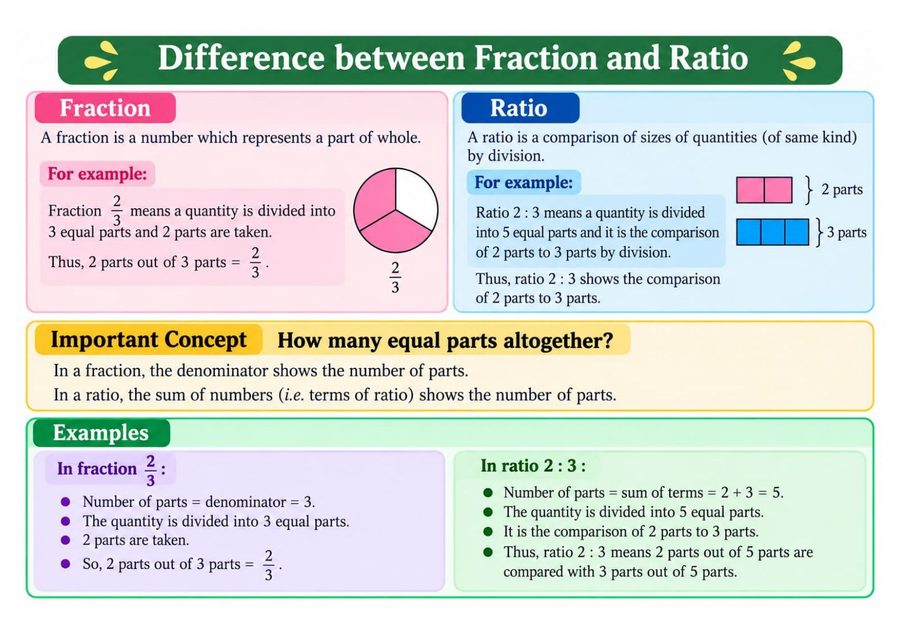
This is the distinction children trip over all year. 3/4 and 3 : 4 are handled identically in every calculation, which makes it tempting to say they are the same thing. They are not:
A fraction compares a part with its whole. A ratio compares one amount with another amount.
If 3 of 4 children are girls, the fraction of girls is 3/4 — but the ratio of girls to boys is 3 : 1. A child who treats these as the same gets the right arithmetic and the wrong answer, which is the hardest kind of mistake to spot.
Dividing a quantity in a given ratio
The one topic in this chapter that appears in nearly every exam paper, and it has a method that always works:
| Step | Example: divide ₹900 between A and B in the ratio 4 : 5 |
|---|---|
| 1. Add the terms | 4 + 5 = 9 parts |
| 2. Find one part | ₹900 ÷ 9 = ₹100 |
| 3. Multiply back | A gets 4 × 100 = ₹400, B gets 5 × 100 = ₹500 |
| 4. Check | 400 + 500 = 900 ✓ — always do this, it costs five seconds |
Proportion, and the unitary method
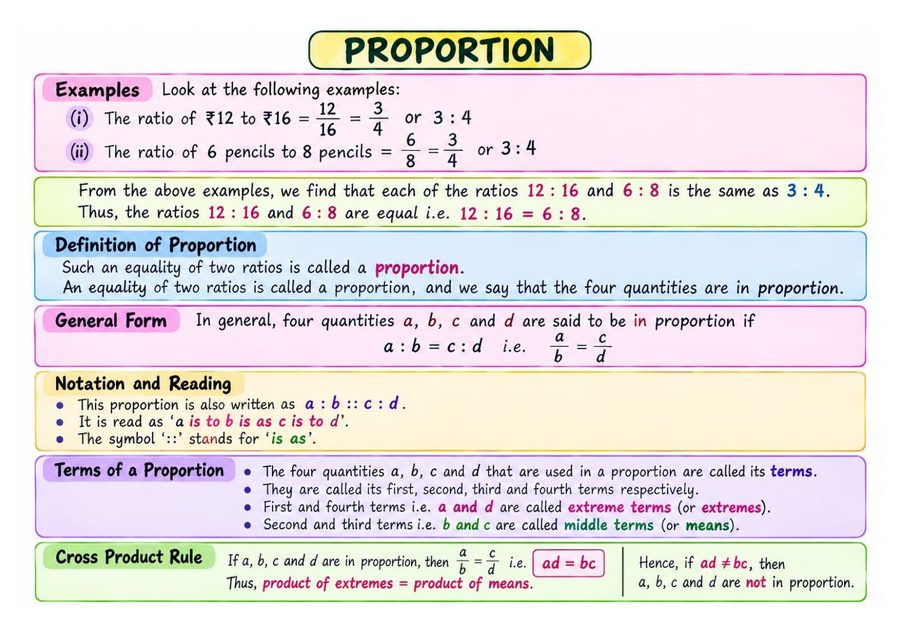
A proportion is nothing more than two ratios that are equal: 2 : 3 = 8 : 12. The useful consequence is that the product of the extremes equals the product of the means, which is what lets a child find a missing term. And the unitary method — find the value of one, then multiply — is the same idea wearing work clothes. It is worth pointing out that they are the same thing; children usually meet them as two unrelated techniques.
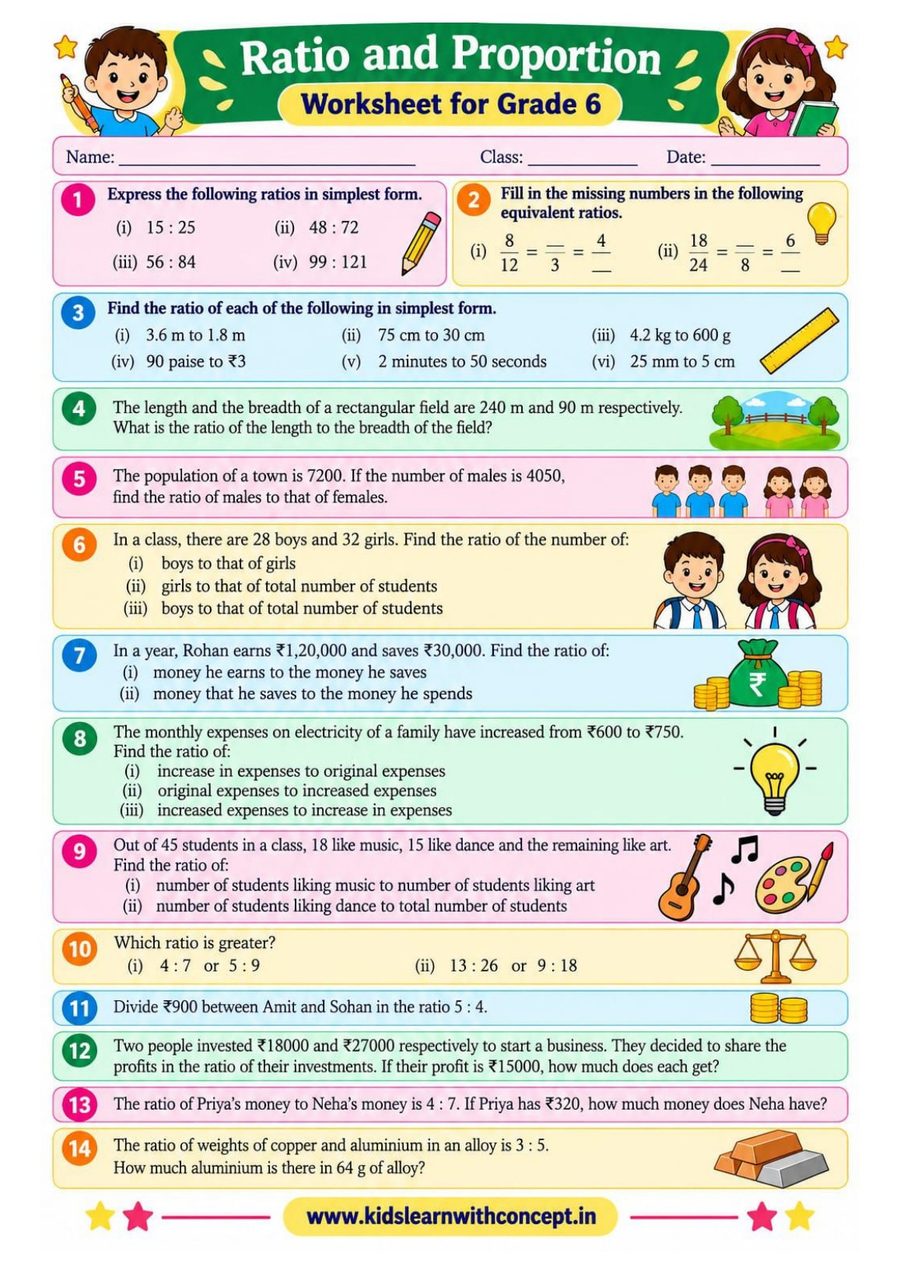
Try two pages free. The concept page and a practice page are in the free Worksheets section, under Maths › Class 6.
Where it goes next
Ratio is not a chapter that ends. It becomes percentage (a ratio with 100 as the denominator), then speed (a ratio of distance to time), then scale drawings, then in Class 7 direct and inverse proportion, and eventually similar triangles in geometry. A child who learnt the procedure will relearn it four times. A child who understood comparison by division will recognise it each time it reappears.