 Kids Learn With Concept
Ask a six-year-old to “write about this picture” and you will usually get one of two things: a single sentence, or nothing at all. It is almost never because the child cannot see what is in the picture. It is because “write about it” is not an instruction a six-year-old can follow. They do not yet know how much to write, where to start, or when they are finished. This guide is about fixing that — not with more practice, but with a smaller, clearer task.
Why four sentences, and not “as much as you can”
A number is an instruction. “Write about the picture” is not.
“Four sentences” does three things at once. It tells the child the task is small, so they begin. It tells them when they have finished, so they stop asking. And it quietly tells them that one sentence is not the answer — which is the single most common thing a Grade 1 child hands back.
Four is also about right for the hand. A six-year-old writing in a ruled book manages four sentences in ten to fifteen minutes before the letters start to collapse. Ask for eight and you get four good lines and four tired ones, and the child learns that writing is something you survive. That is a worse outcome than writing less.
The four questions
This is the part worth teaching, because it works on every picture the child will ever be given, in school or in an exam. Four questions, always in the same order:
| # | Ask the child | What it produces |
|---|---|---|
| 1 | What is this a picture of? | The opening sentence. “This is a picture of a house.” |
| 2 | What can you see in it? | A detail sentence. “It has a big door and two windows.” |
| 3 | What else is nearby? | A second detail. “There is a tall tree near the house.” |
| 4 | What is happening in the sky, or all around? | The closing sentence. “The sun is shining in the sky.” |
Say them out loud together first, pointing at the picture. The child answers in speech before they write a word. This is not a shortcut — it is the whole method. A child who has already said the sentence has solved the hard problem; writing it down is just transcription. A child who is inventing and spelling at the same time is doing two difficult things at once, and will do both badly.
Say it, then write it. Never the other way round.
What helping words are actually for
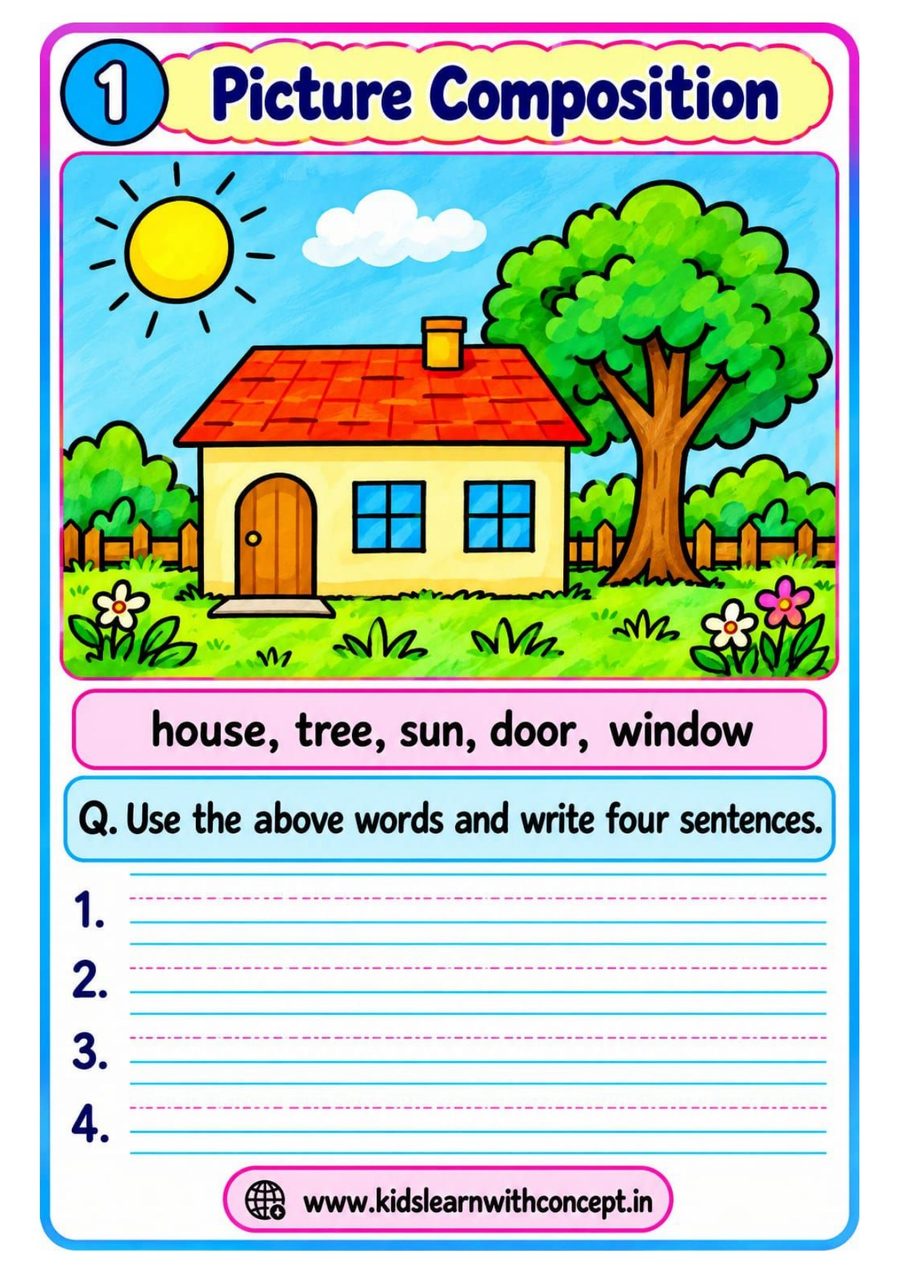
Every page in the workbook has a strip of five words under the picture — house, tree, sun, door, window. Parents often treat these as a vocabulary list. They are not. They are there to remove the spelling excuse.
The commonest reason a six-year-old stops mid-sentence is that they have reached a word they cannot spell, and rather than guess they abandon the sentence and write something shorter and safer. Printing the five likely words where the child can see them takes that exit away. The child who can copy window off the page writes the sentence they wanted to write.
Start with a solved one. Always.
The first picture in the book is already answered, and this is deliberate. Showing a child a finished example is worth more than any amount of explaining, because the thing they are missing is a shape, not information. They know what a house looks like. They do not know what four sentences about a house look like.
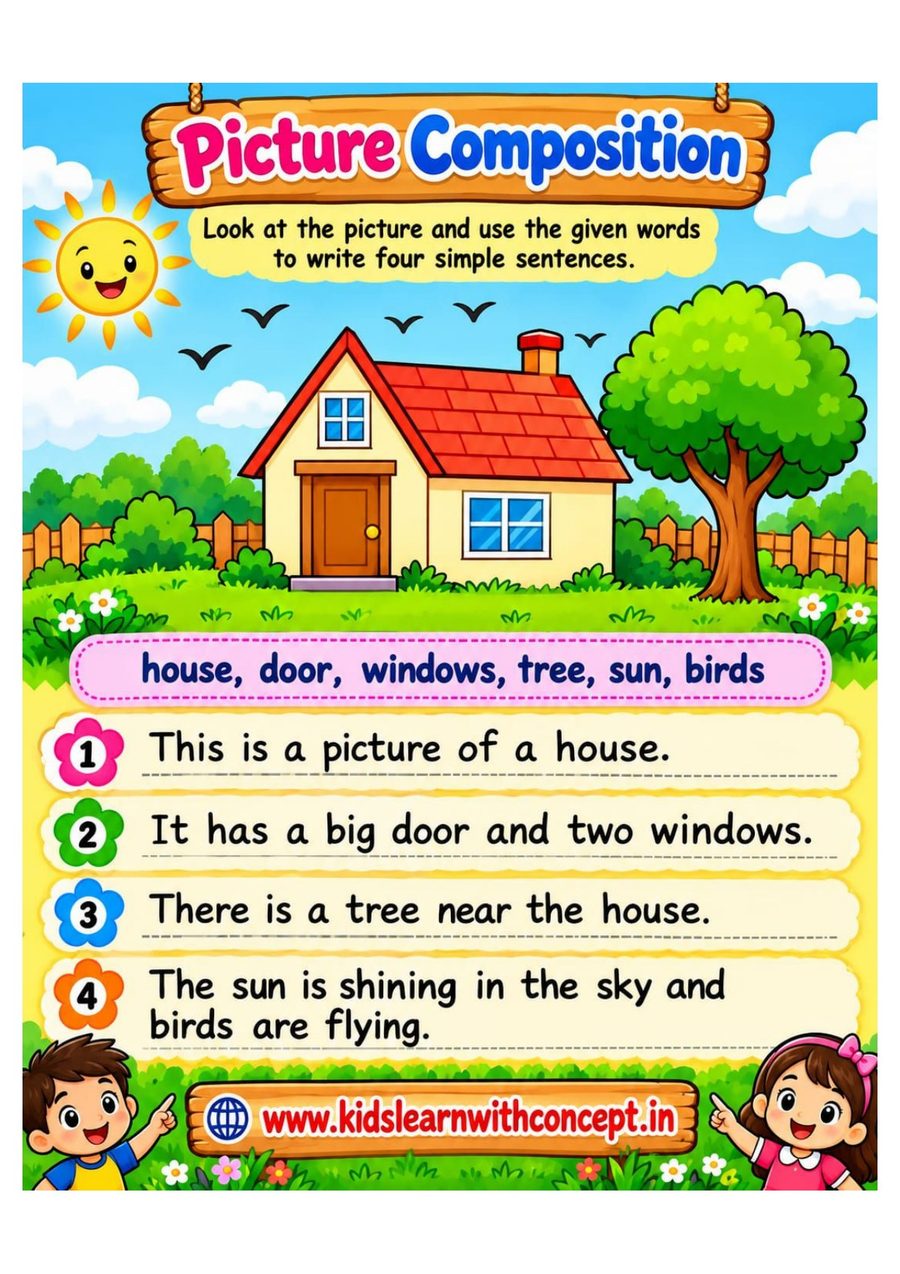
Read the four sentences aloud with the child, then go back and ask: which helping word is in sentence one? And sentence two? Thirty seconds of that and the child has worked out the pattern on their own, which is far stickier than being told it.
The five mistakes grown-ups make when marking
| The mistake | Do this instead |
|---|---|
| Correcting spelling while the child is still writing | Let them finish all four sentences. Then fix spelling, gently, together. Interrupting mid-sentence is how children lose the thought they were holding. |
| Treating the model answer as the right answer | There is no right answer in picture composition. If the child's four sentences describe the picture correctly, the child is correct — even if not one word matches the book. |
| Accepting “A house.” as a sentence | Ask: “Can you say that as a whole sentence?” A sentence needs someone and something happening. This is the one thing worth being firm about. |
| Letting all four sentences start with the same words | After two sentences beginning “There is…”, ask “can you start this one with a different word?” Variety of sentence opening is what Class 2 will be marked on. |
| Asking for more once the child has done four | Four was the deal. Keeping the deal is what makes the child willing to start next time. |
What to check in each sentence
Capital letter at the start. Full stop at the end. One helping word used. Something that is really in the picture.
That is the whole mark scheme at this age. Four boxes, ticked quickly. Anything beyond that — tense agreement, adjectives, joining words — belongs to Class 2 and after, and chasing it now costs more in confidence than it gains in grammar.
Thirty pictures, and why the ordinary ones work best
The pictures that produce the best writing are the ones the child already has words for: a house, the school bus, a rainy day, a birthday party, the kitchen, bedtime with a teddy bear. A child who has lived the scene brings sentences to it. An exotic picture produces careful, empty writing.
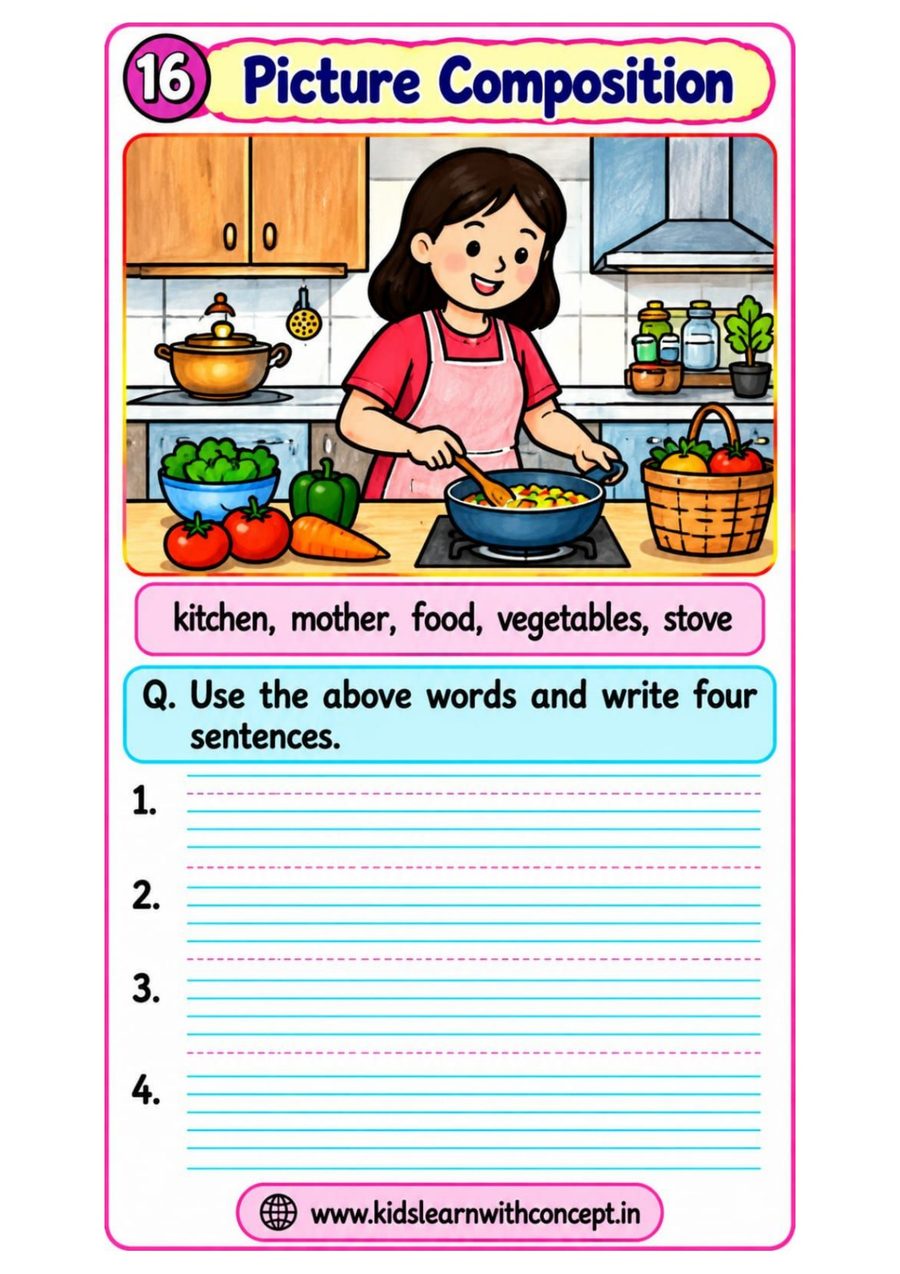
A fifteen-minute routine, twice a week
| Minutes | What you do |
|---|---|
| 0–2 | Look at the picture together. No pencils yet. “Tell me four things you can see.” |
| 2–4 | Read the five helping words aloud. Find each one in the picture. |
| 4–6 | The four questions. The child says all four sentences. |
| 6–13 | The child writes. You say nothing at all. |
| 13–15 | Read it back together. Check the four boxes. Praise one specific thing — a word, not the whole page. |
Twice a week is plenty. Thirty pictures at that rate is a full school term, which is about how long it takes for “I don't know what to write” to stop being said at all.
Model answers — how to use them without spoiling it
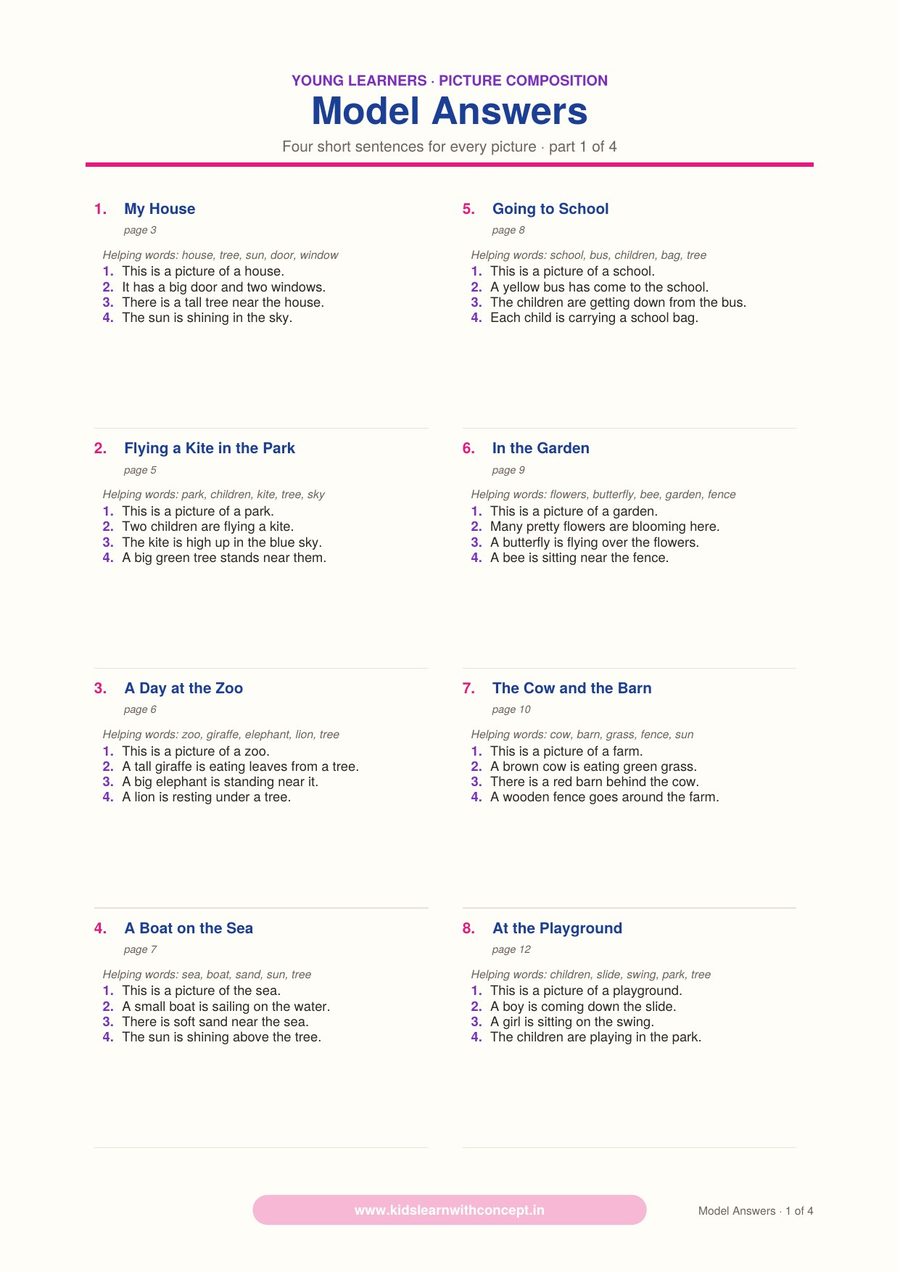
Keep the back of the book closed while the child writes. Afterwards, comparing is useful and quite enjoyable: the book said ‘a tall tree’, you said ‘a big tree’ — both are right, which do you like better? That conversation teaches more about writing than correcting ever does.
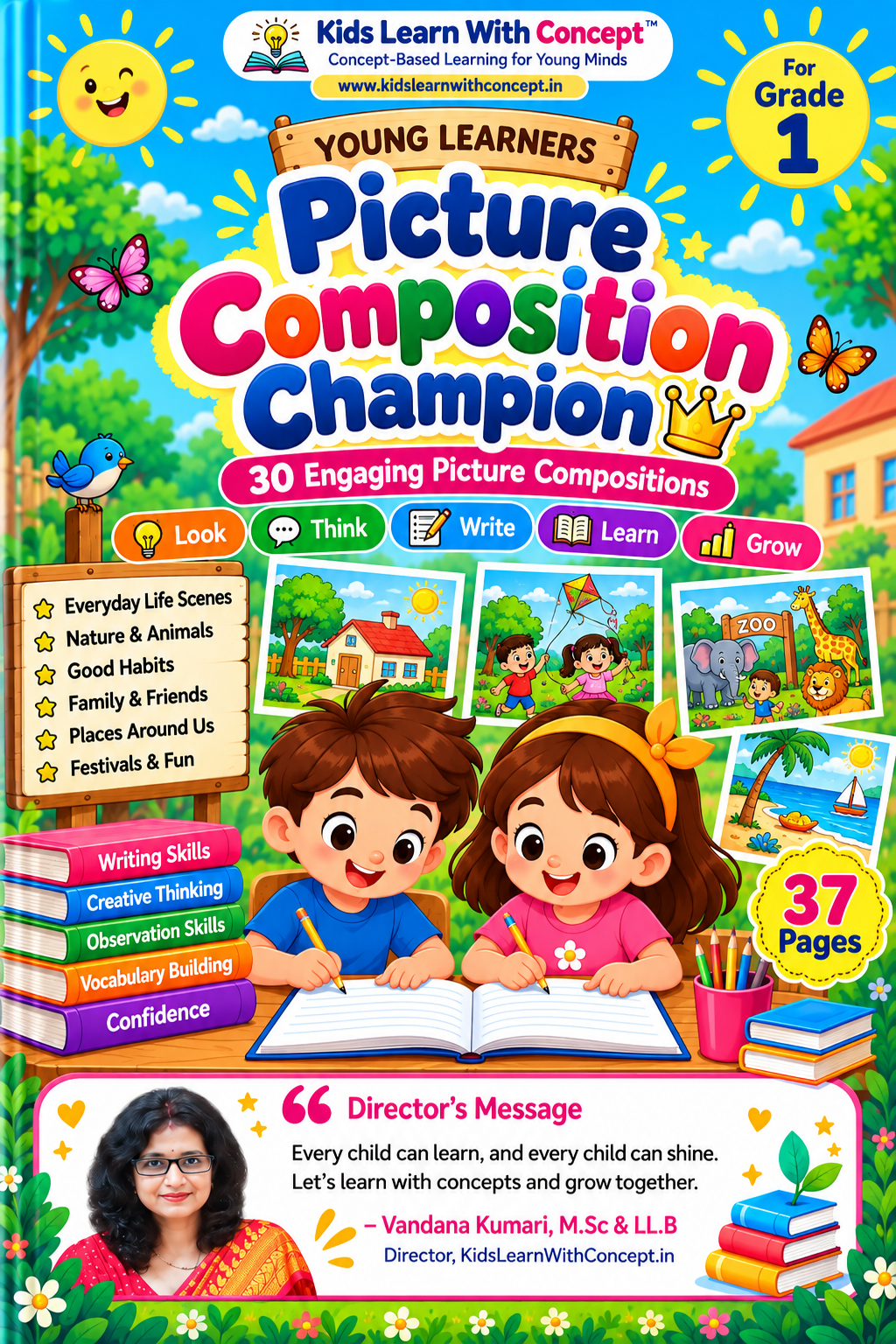
Try two pages free. Two worksheets from this book are in the free Worksheets section — My House (which includes the solved example page) and At the Playground. Print them, try the four questions, and see how your child gets on before buying anything.
What comes next
When four sentences have stopped being hard — usually some time in Class 2 — the task changes shape rather than just getting longer. The child starts being asked for eight to ten sentences, and for one sentence that is not a description at all: what might happen next, or how the people in the picture feel. That step is covered in Picture Composition for Class 2.