 Kids Learn With Concept
Class 1 is the year English stops being letters and starts being sentences. A child arrives able to name things and leaves able to write four lines about their mother. What happens in between is fifteen small ideas, each of which takes a week or two and each of which depends on the one before it. Teach them out of order and a child stalls; teach them in order and the whole year feels easy. Here is the order, with the rule for each one.

The fifteen chapters, and what each one really teaches
| # | Chapter | The idea underneath it |
|---|---|---|
| 1 | The Alphabet | Capital and small letters are the same letter — and matching BAG to bag is harder than it looks |
| 2 | A, An, The | A before a consonant sound, an before a vowel sound, the for something we both already know about |
| 3 | Naming Words | Persons, places, animals, things — and special names take a capital letter |
| 4 | One and Many | Add -s; add -es after s, sh, ch and x |
| 5 | I, You, He, She, It | Words that stand in place of a name |
| 6 | Describing Words | The word that tells us which or what kind of thing |
| 7 | Action Words | What the naming word is doing |
| 8 | Is, Am, Are | Am goes only with I; is with one; are with more than one |
| 9 | Has, Have | Has for one, have for more than one — and for I, you, we, they |
| 10 | Position Words | On, in, under, behind — where a thing is |
| 11 | Sentences | A group of words that makes complete sense, capital at the start, full stop at the end |
| 12 | Joining Words | And, but, or — two short sentences become one good one |
| 13 | Fun with Words | Rhymes, opposites, word building — the chapter that keeps the year enjoyable |
| 14 | Composition | Four or five sentences on one subject, in order |
| 15 | Story Writing | Reading a short story, finding its moral, then telling one back |
Chapter 1 is not as easy as it looks
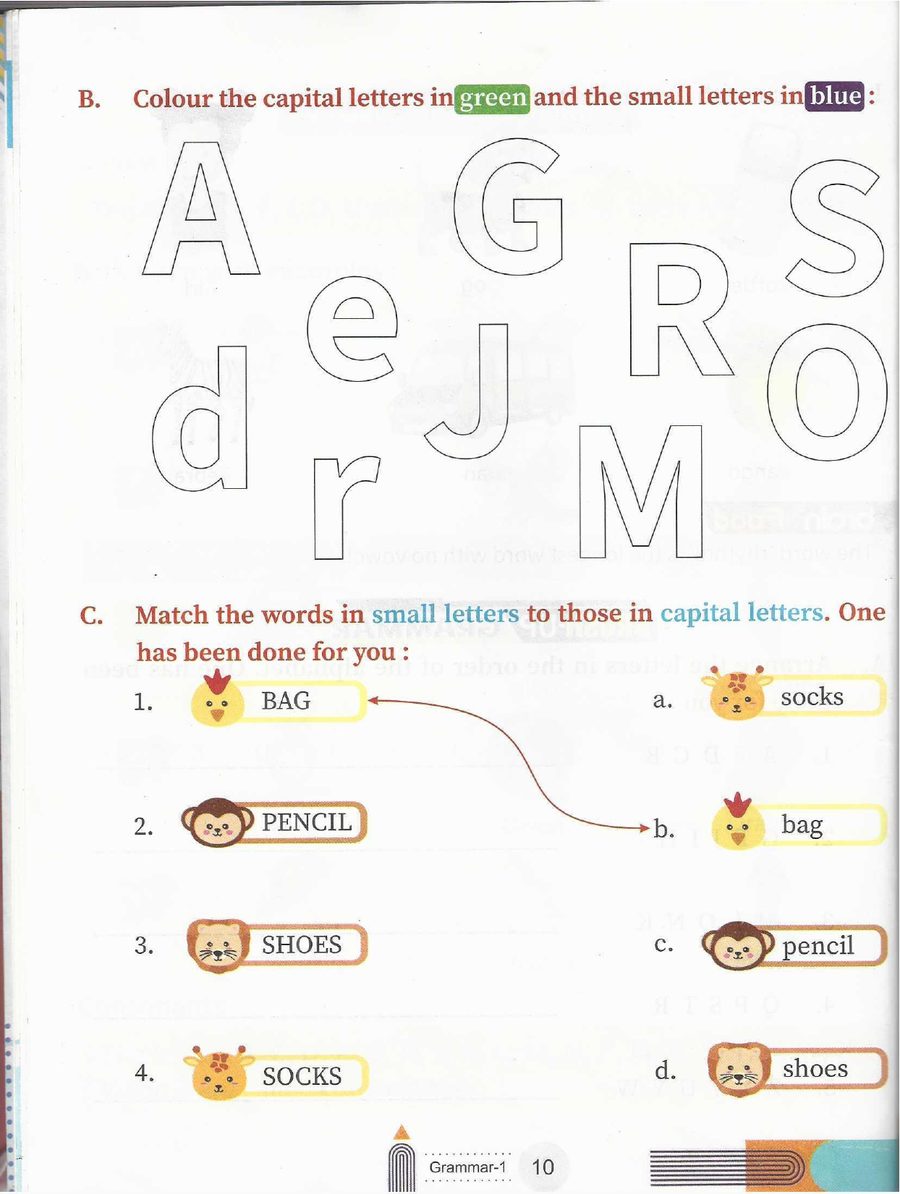
Every Class 1 book opens with the alphabet and every parent skips it, because the child already knows their letters. They know the capitals. Ask a five-year-old to draw a line from PENCIL to pencil and you will find out how separate the two sets still are in their head — especially for the letters that change shape completely: A and a, G and g, R and r, E and e.
Why the -es rule needs pictures
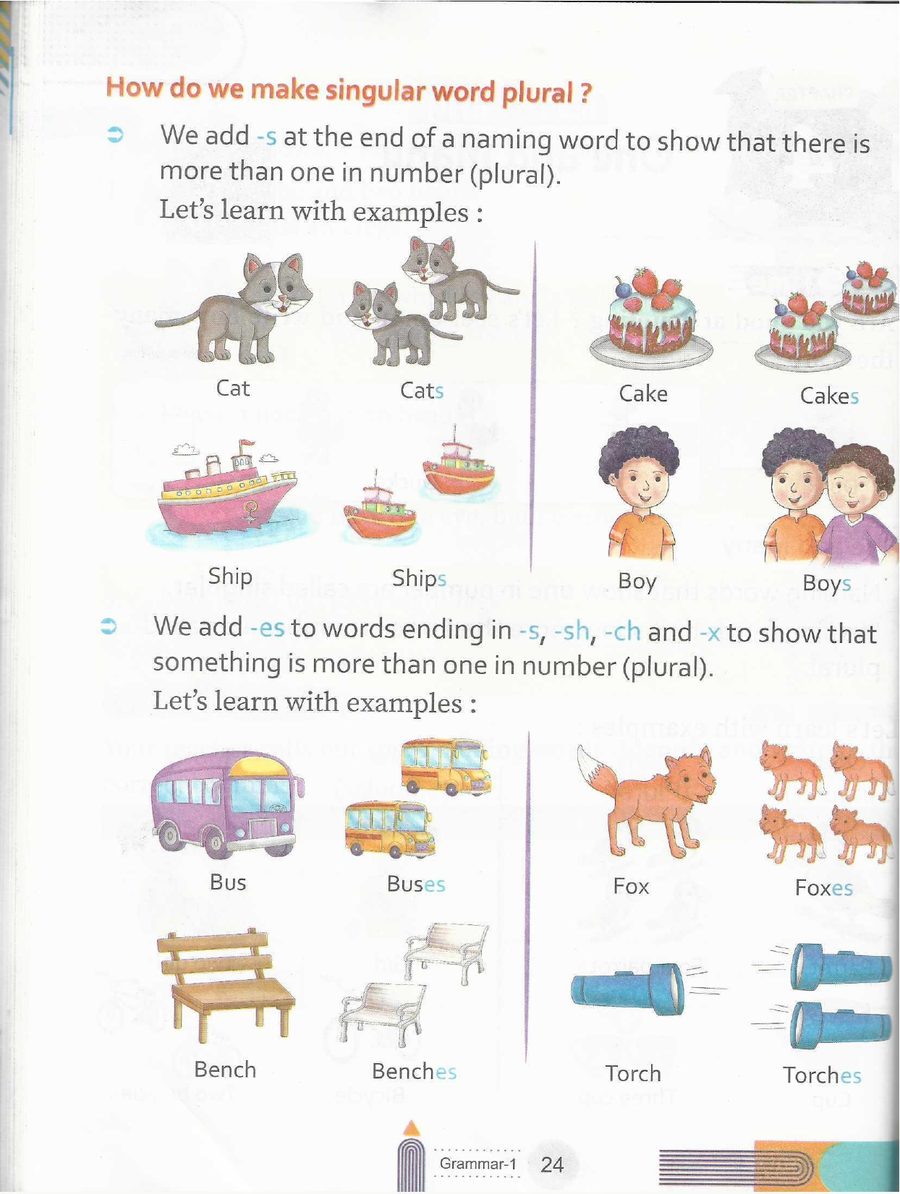
⭐ Add -s to show more than one. Add -es when the word ends in s, sh, ch or x.
A child cannot hear why buses takes an extra e but ships does not — and explaining the hiss at the end of the word to a six-year-old rarely lands. What does land is seeing one bus and then three buses on the same line, with the es printed in a different colour. They learn the shape of the word before they learn the reason for it, which is the right way round at this age.
Is, am, are — taught inside a story
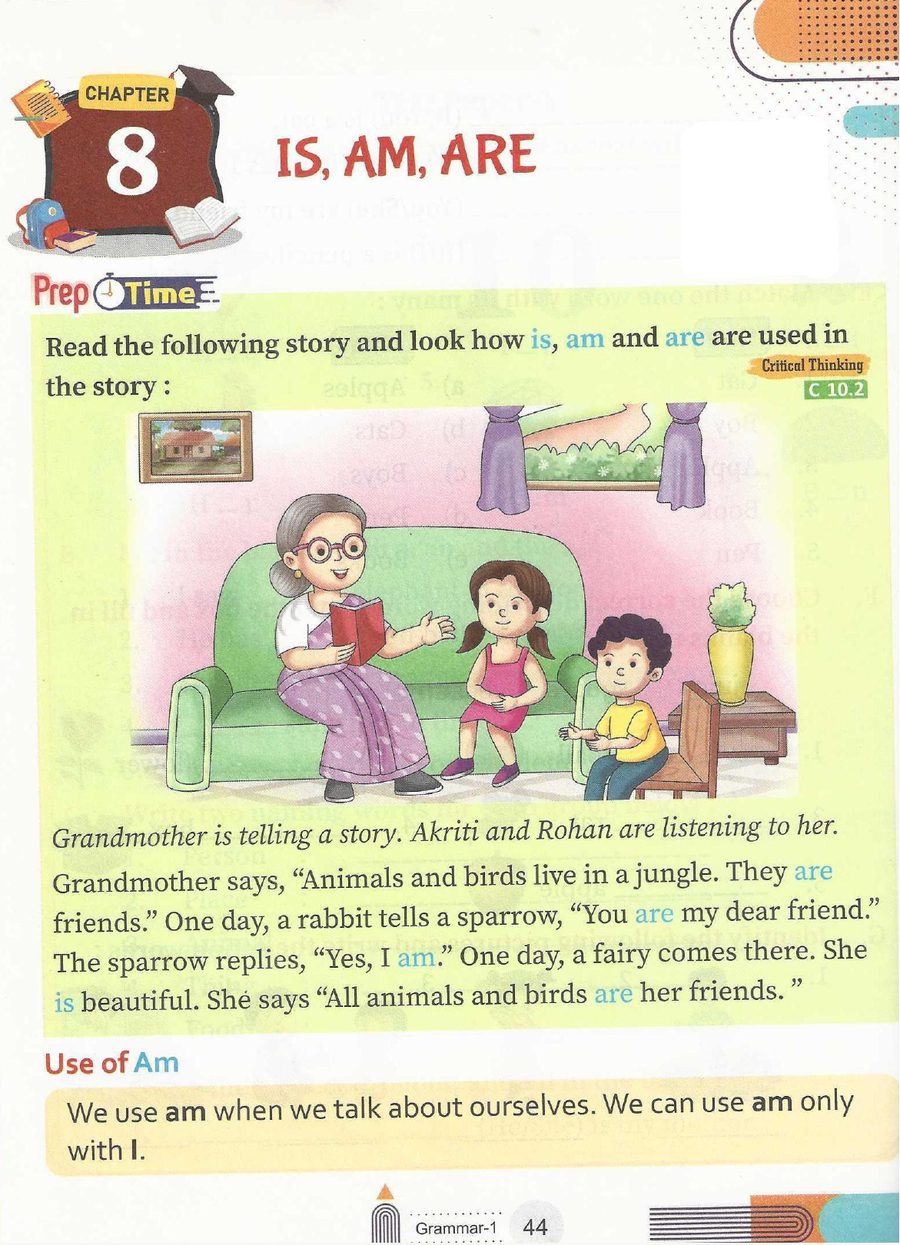
This is the chapter where a workbook either wins a child over or loses them. Taught as a table, it is three words and a list of rules. Taught as a grandmother telling a story to Akriti and Rohan — “Animals and birds live in a jungle. They are friends.” — the rule arrives inside a sentence the child wants to finish.
From grammar to composition — the bridge most books miss
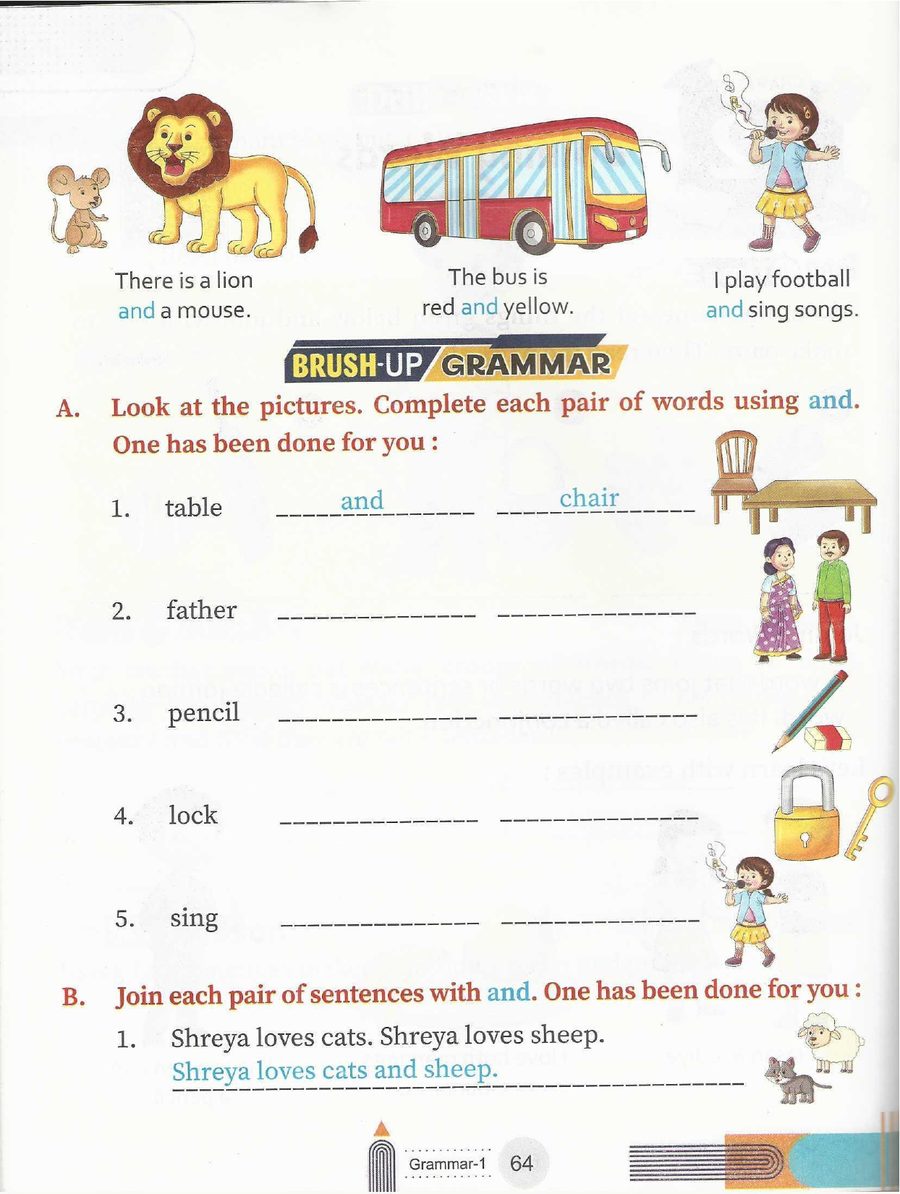
Chapters 1 to 13 are grammar. Chapters 14 and 15 are writing, and the jump between them is where most Class 1 children get stuck. The bridge is chapter 12: joining words. A child who can turn “Shreya loves cats” and “Shreya loves sheep” into “Shreya loves cats and sheep” has just written a longer sentence than they have ever written before, without being asked to think of anything new. Do that a dozen times and composition stops being frightening.
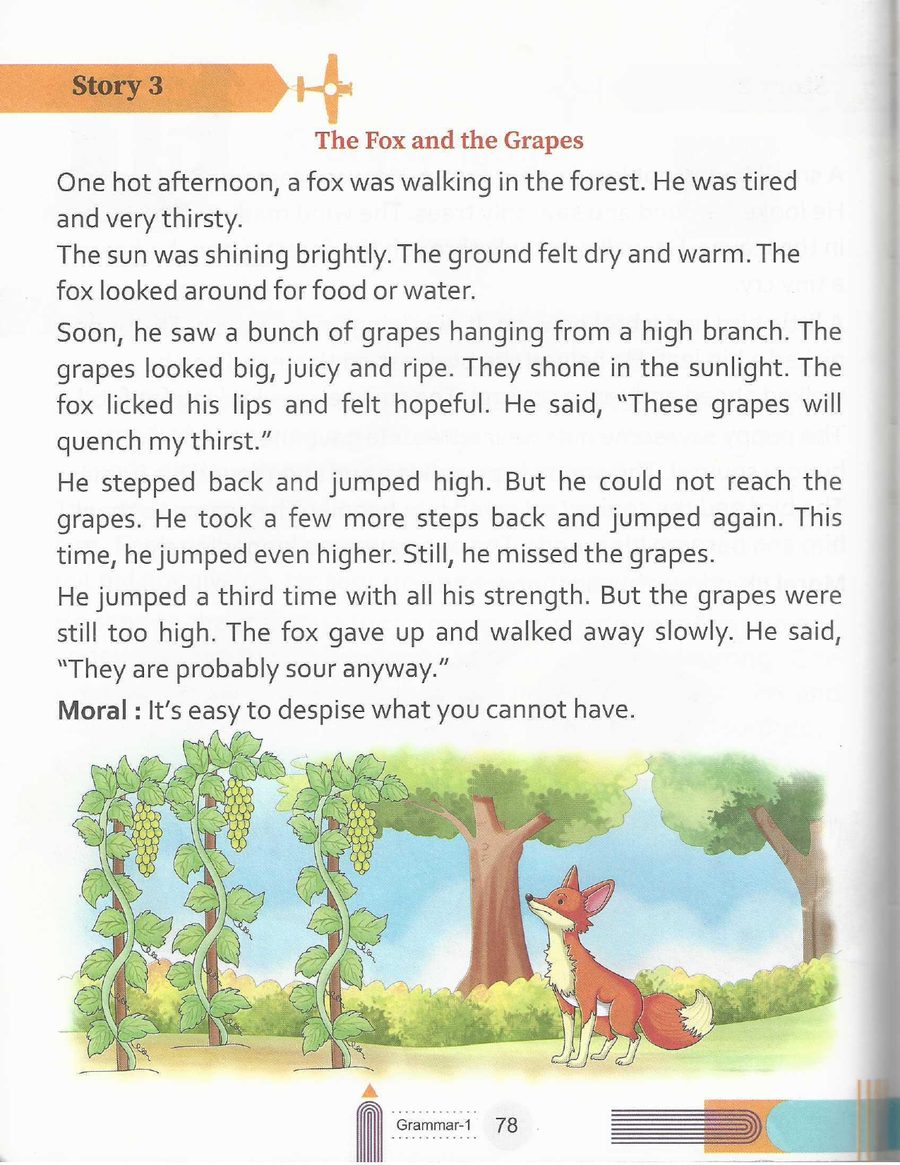
Story writing then works backwards: read a short story, say what happened, say what it means, and only then write. The Fox and the Grapes ends with “It’s easy to despise what you cannot have” — and a six-year-old asked what the fox really thought about those grapes will usually give you a better answer than the book’s.
How to run a week
| Day | What you do |
|---|---|
| Monday | Read the lesson page together. Say the rule aloud twice. No writing. |
| Tuesday | The first practice page, with you sitting beside them. |
| Wednesday | The second practice page, alone. Mark it together afterwards. |
| Thursday | Use the rule out loud, away from the book — five sentences about the room you are in. |
| Friday | Listening exercise or a short test paper. Then stop for the week. |
⭐ One chapter a week, fifteen chapters, and the school year has room to spare. There is no prize for finishing in March.
Two questions parents ask
Worth answering before you start
- “Should I correct every mistake?” No. Correct the rule being taught this week and let the rest go. A page covered in red teaches a child that writing is dangerous.
- “My child can say it but writes it wrong.” That is normal and it is progress, not failure. Speaking runs months ahead of writing at this age; the hand catches up on its own.
English Grammar and Composition — Class 1
All fifteen chapters in the order above, with simple explanations, clear examples and plenty of colourful practice.
- Concept first — the rule in a child’s words, with pictures, before any blank has to be filled.
- Test papers and Listening for the Teacher exercises built in.
- Composition and story writing chapters that grow out of the grammar rather than sitting apart from it.
- A complete answer key for grown-ups at the back.
Instant download · Print at home and reuse forever · Written by educator Vandana Kumari (M.Sc, LL.B). For picture-led lessons on the same chapters, see the Grade 1 Grammar series below.