 Kids Learn With Concept
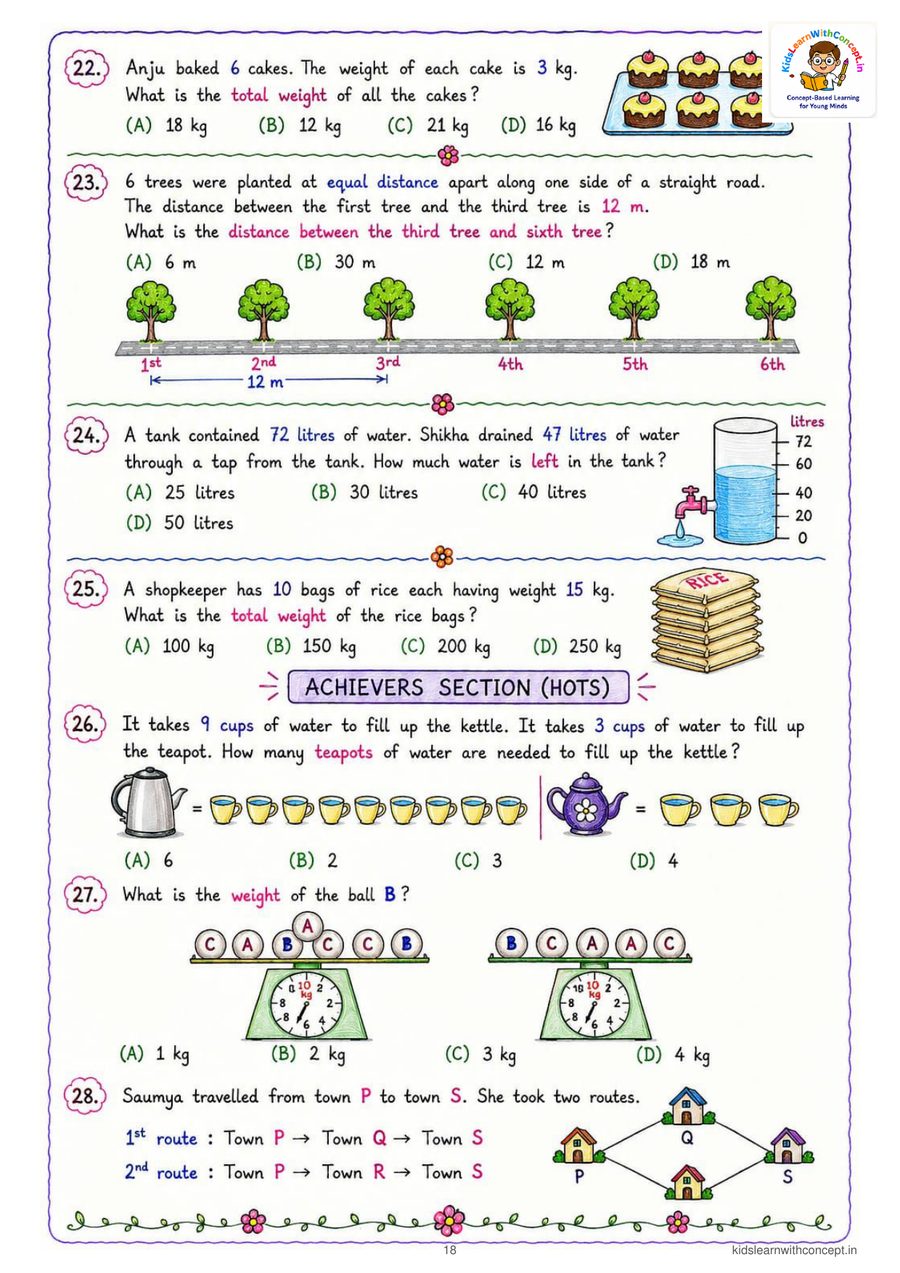
The first thing to say about an olympiad at Class 1 and 2 is that it is not an arithmetic race. Your child will not be asked to add faster than anyone else. They will be shown four houses with numbers on them and asked which has the greatest, or three groups of shapes and asked which one is different. It is a thinking paper dressed up in maths, and that is excellent news — because thinking is something a six-year-old can practise for fifteen minutes a day without ever feeling tested.

What the questions actually look like
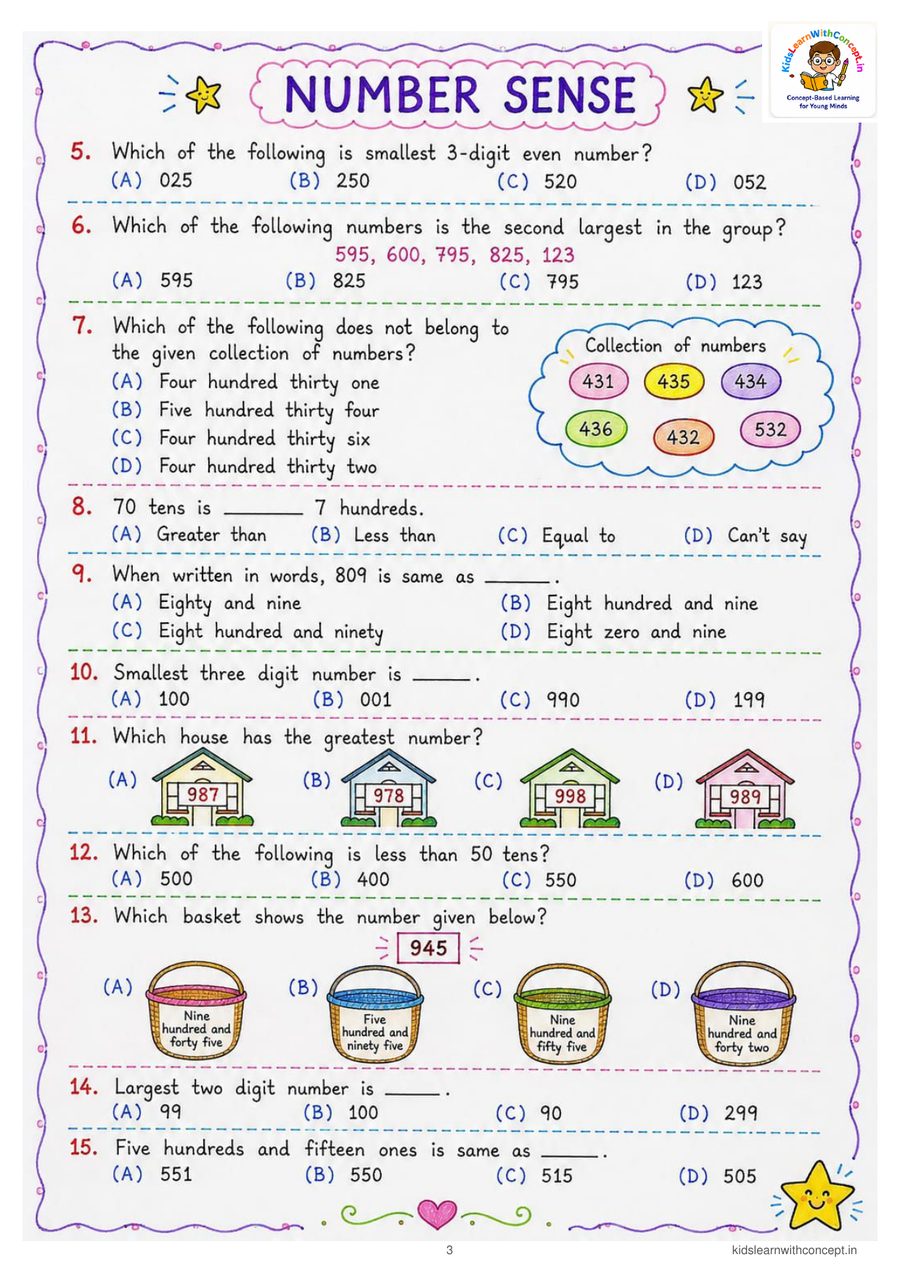
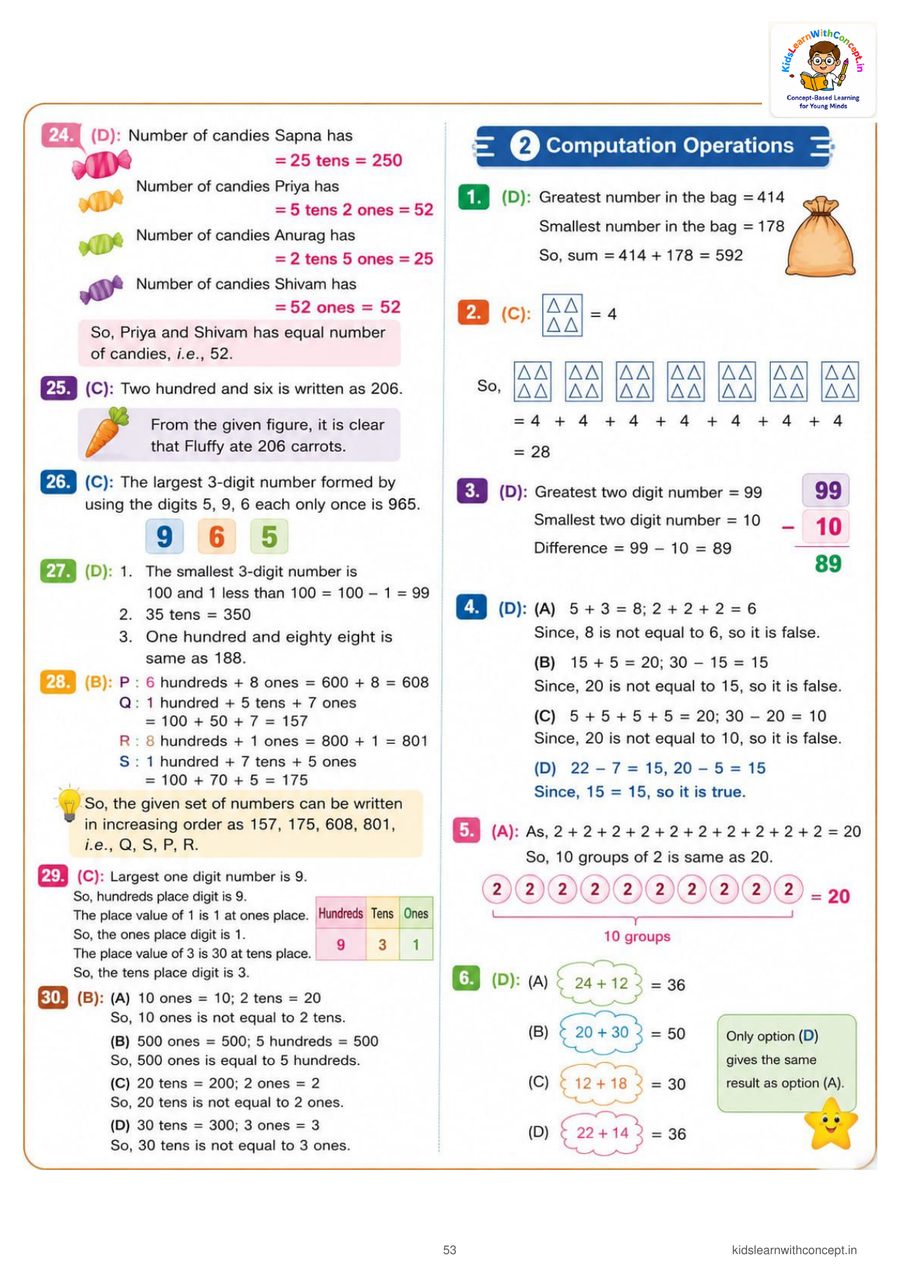
Here is a real one: Which of the following is the smallest 3-digit even number? with the options 025, 250, 520 and 052. A child who can count to a thousand may still get this wrong, because the question is really asking three things at once — what counts as a 3-digit number, what makes a number even, and which of the survivors is smallest. Nothing in it is hard. It is the stacking that is new.
⭐ At this level, almost every wrong answer comes from reading the question too fast — not from weak arithmetic.
The eleven kinds of reasoning question
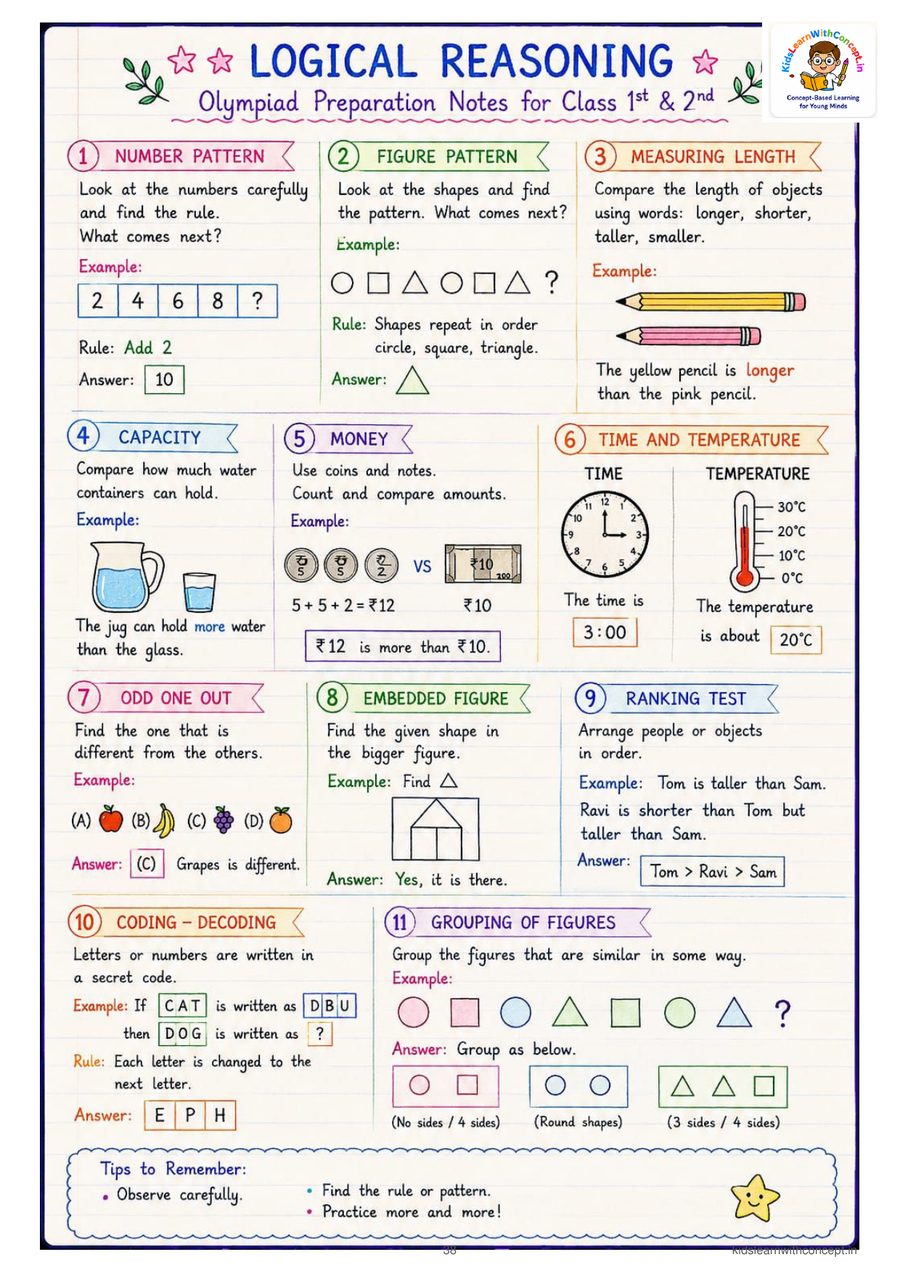
Logical reasoning is the part most parents have never seen before, and it is the part that separates ranks. There are only eleven shapes of question, and every one of them can be practised at the kitchen table:
| Type | What the child has to spot |
|---|---|
| Number pattern | What comes next: 2, 4, 6, 8, ? — find the rule, then apply it |
| Figure pattern | The same idea with shapes instead of numbers |
| Measuring length | Longer, shorter, tallest — comparing without a ruler |
| Capacity | Which container holds more |
| Money | Count the coins and notes, then compare two amounts |
| Time and temperature | Read a clock face; read a thermometer |
| Odd one out | Which of these four does not belong, and why |
| Embedded figure | Find the small shape hidden inside the bigger one |
| Ranking test | Tom is taller than Sam, Ravi is shorter than Tom — put them in order |
| Coding and decoding | If CAT is written as DBU, how is DOG written? |
| Grouping of figures | Put the shapes that are alike into the same group |
Read that list to a parent and it sounds like an aptitude test. Watch a child do it and it looks like a puzzle book. That difference in framing is the single most useful thing you can give them this year.
A four-week start, fifteen minutes a day
| Week | Focus | What it looks like at home |
|---|---|---|
| 1 | Number sense | Compare, order, odd and even, numbers in words. Use real things — buttons, steps, floors in a building. |
| 2 | Patterns and reasoning | One pattern and one odd-one-out a day, said out loud. No writing at all this week if the child would rather not. |
| 3 | Measurement, money, time | Coins on the table, the kitchen scale, the clock on the wall. Ask the question about the real object first, the page second. |
| 4 | Mixed sets and Achievers | Shuffle the chapters so the child does not know what is coming — this is what an olympiad feels like. |
⭐ Fifteen minutes, four days a week, is plenty at this age. A tired six-year-old learns nothing, and a frightened one learns less than nothing.
Reading the answer key together
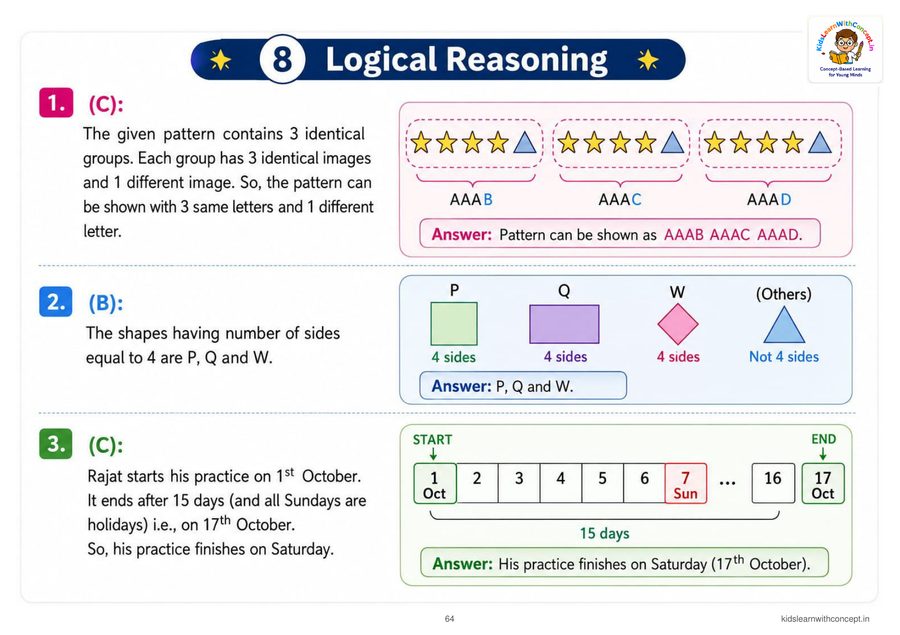
At Class 1 and 2 a child cannot mark their own work, so the answer key is really a page for the grown-up. The useful ones do not print a bare letter — they show the reasoning in a sentence a child can follow, and that sentence is what you read aloud when the answer was wrong.
Four things that go wrong, and the fix
Worth knowing before you start
- Treating it like homework. Call it a puzzle, do it on the floor, do it out loud. The content is identical; the child’s face is not.
- Explaining before they have tried. Give them a full minute of silence first, even when you can see they are stuck.
- Only practising what they are good at. Most children love number questions and avoid figure patterns. Alternate deliberately.
- Chasing a rank in the first year. At Class 1, the point is to meet the question types once, calmly. The rank comes in Class 3 and 4, and only for children who still enjoy it.
Should a Class 1 child sit an olympiad at all?
Only if they want to. The reasoning practice is worth doing either way — it feeds directly into the maths they will meet for the next five years, and it is genuinely good fun on a rainy afternoon. But the exam hall itself is optional at this age, and a child who is dragged into it at six is usually the child who refuses at nine. Practise the puzzles; decide about the paper later.
Maths Olympiad Champions — Class 1 & 2
70 pages and 15 chapters covering exactly the ground above — number sense, mathematical reasoning, patterns and sequences, measurement, time and money, data handling, geometry, word problems and a set of fun, challenging questions.
- Concept first, with the rule and a worked example before any question is asked.
- Olympiad-style practice with pictures a young child can read, plus an Achievers (HOTS) section in every chapter.
- A complete answer key that explains the reasoning, not just the letter.
Instant download · Print at home and reuse forever · Written by educator Vandana Kumari (M.Sc, LL.B). A Class 3 & 4 edition is also available.