 Kids Learn With Concept
A child who can write four good sentences about a picture has solved the starting problem. The Class 2 problem is different and nobody warns parents about it: asked for ten sentences, most children write the same four sentences twice, in a slightly different order. The page is full and the writing has not improved. This guide is about the structure that fixes that, and about the single extra sentence that moves a child from describing a picture to composing about one.
Why ten sentences goes wrong
A longer paragraph is not four sentences repeated. It is four kinds of sentence.
When a child is told to write more, the only tool they have is to keep naming things. Sentence five names another object, sentence six names another, and by sentence nine the paragraph has become a list — grammatically fine, and dull to read. The teacher's comment is usually “good, but try to write more interestingly”, which is not something a seven-year-old can act on.
What they need is not more effort. It is a different order.
The order that fills ten lines without repeating
| Lines | What this part does | Example — a school garden |
|---|---|---|
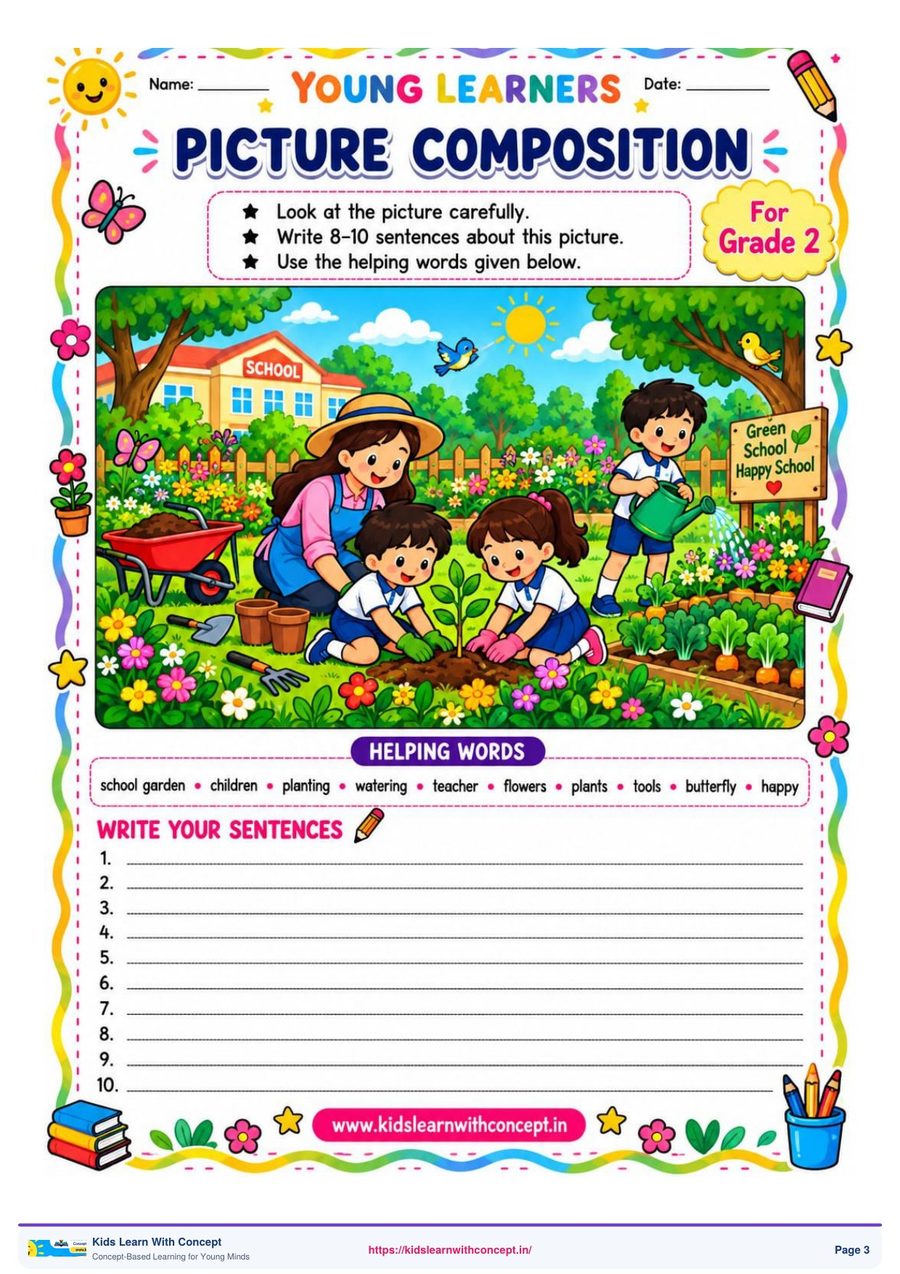
| 1 | Where we are. One sentence naming the scene. | This is a picture of our school garden. |
| 2–3 | Who is there, and what they are doing. People before objects — this is the change from Grade 1. | The teacher is helping the children. Two children are planting a small plant. |
| 4–6 | What else is happening. Other actions, not other objects. Look for verbs in the picture. | A boy is watering the plants with a green can. A butterfly is flying over them. Garden tools are lying on the grass. |
| 7–8 | Detail that proves you looked. A colour, a number, something written in the picture. | Many flowers are blooming in the garden. The board says ‘Green School, Happy School’. |
| 9 | How it feels, or what happens next. The sentence that is not description. | All the children look very happy. |
Nine lines, no repetition, and every one of them is doing a different job. The child is not writing more — they are writing a sequence. Once this order is in the head it never leaves, and it is the same order a Class 5 essay uses.
People first. This is the whole difference.
Grade 1 asks what is in the picture. Class 2 asks what is going on in it.
A Grade 1 paragraph is a list of nouns with is in front of them. A Class 2 paragraph is built on verbs. The quickest way to make a child's writing grow up is to stop them naming things and start them naming actions: who is doing what. Ask “what is that boy doing?” rather than “what can you see?” and the sentences change immediately.
It also fixes the length problem on its own. A picture contains perhaps eight nameable objects, but a busy picture contains fifteen actions, and actions are more interesting to read.
The one sentence that separates Class 3 from Class 2
A Class 2 child who describes a picture accurately in ten sentences has done the task. A Class 3 child is expected to add one sentence that is not in the picture at all:
| Kind | What it sounds like |
|---|---|
| How they feel | The children look proud of what they have grown. |
| What happens next | Soon the plants will grow tall and the whole garden will be green. |
| Why it matters | Working together makes the job easy and fun. |
One sentence. That is all. But it is the sentence that makes a reader feel they are reading somebody's writing rather than an inventory, and it is almost always what the extra marks are for. Ask for it by name: “now one more line — not what you can see, but how you think they feel.”
Using the helping-words box properly
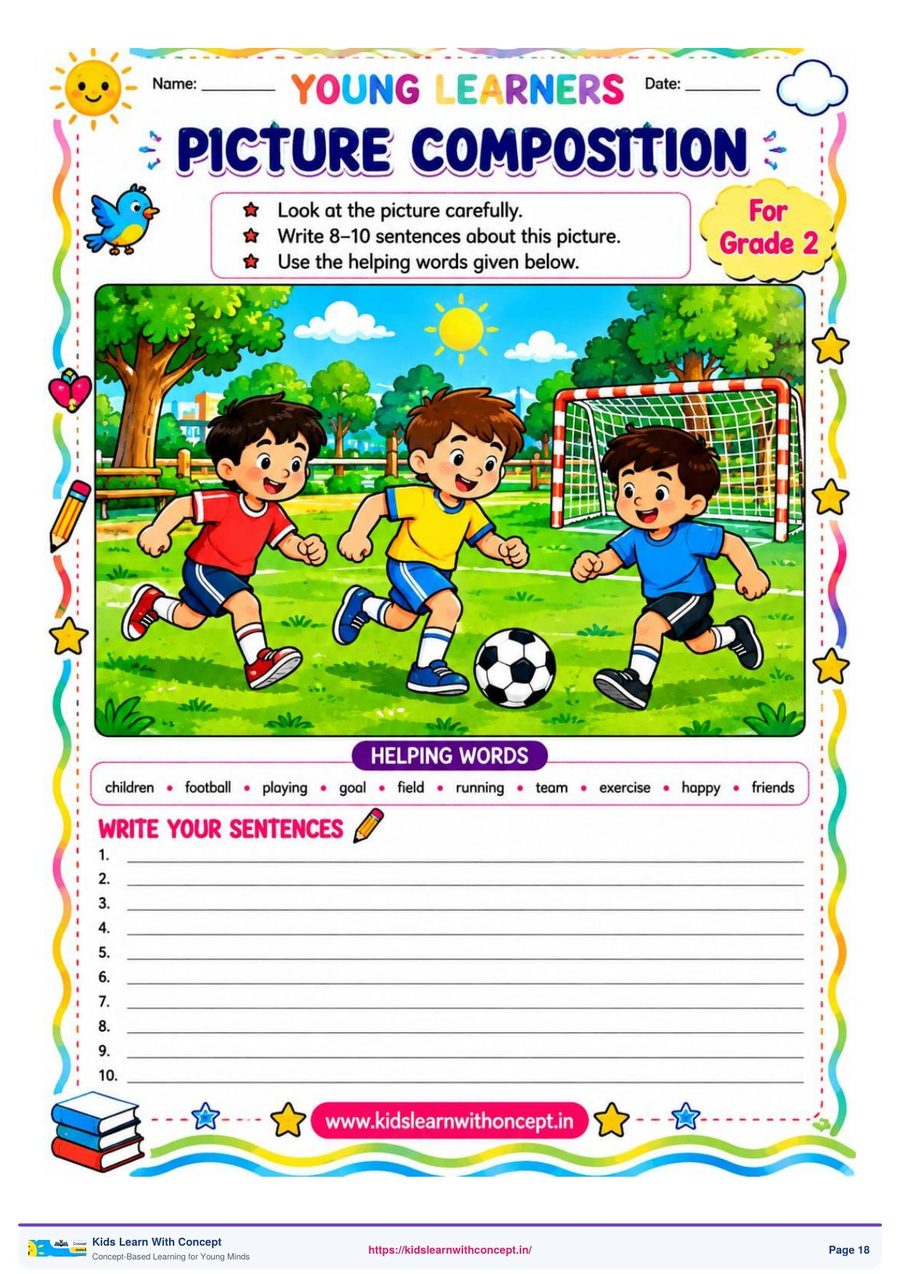
In Grade 1 the helping words exist so the child does not stall on spelling. By Class 2 the job has changed: they are a coverage check. Before writing, have the child point to each word in the picture. After writing, have them tick the words they used. A child who has used all of them has almost certainly covered the whole picture rather than one corner of it.
Then push past: “the box gives you eight words — find me two more things nobody listed.” Noticing something the page did not point at is exactly the habit a comprehension paper rewards later.
A marking scheme you can actually use
| Look for | Why |
|---|---|
| Eight to ten sentences | The stated task. Count them with the child, out loud. |
| At least five different sentence openings | The cure for a paragraph where every line starts “There is…”. This one check improves writing faster than any other. |
| People and actions, not only objects | The Class 2 step. If every sentence names a thing, the paragraph has not moved on from Grade 1. |
| One sentence that is not description | The Class 3 step. Feeling, consequence, or what happens next. |
| Capitals, full stops, and a sensible tense throughout | Whichever tense the child starts in — just not both. |
Five checks, two minutes. Mark the writing, not the handwriting.
Thirty-two pictures, and the ones to start with
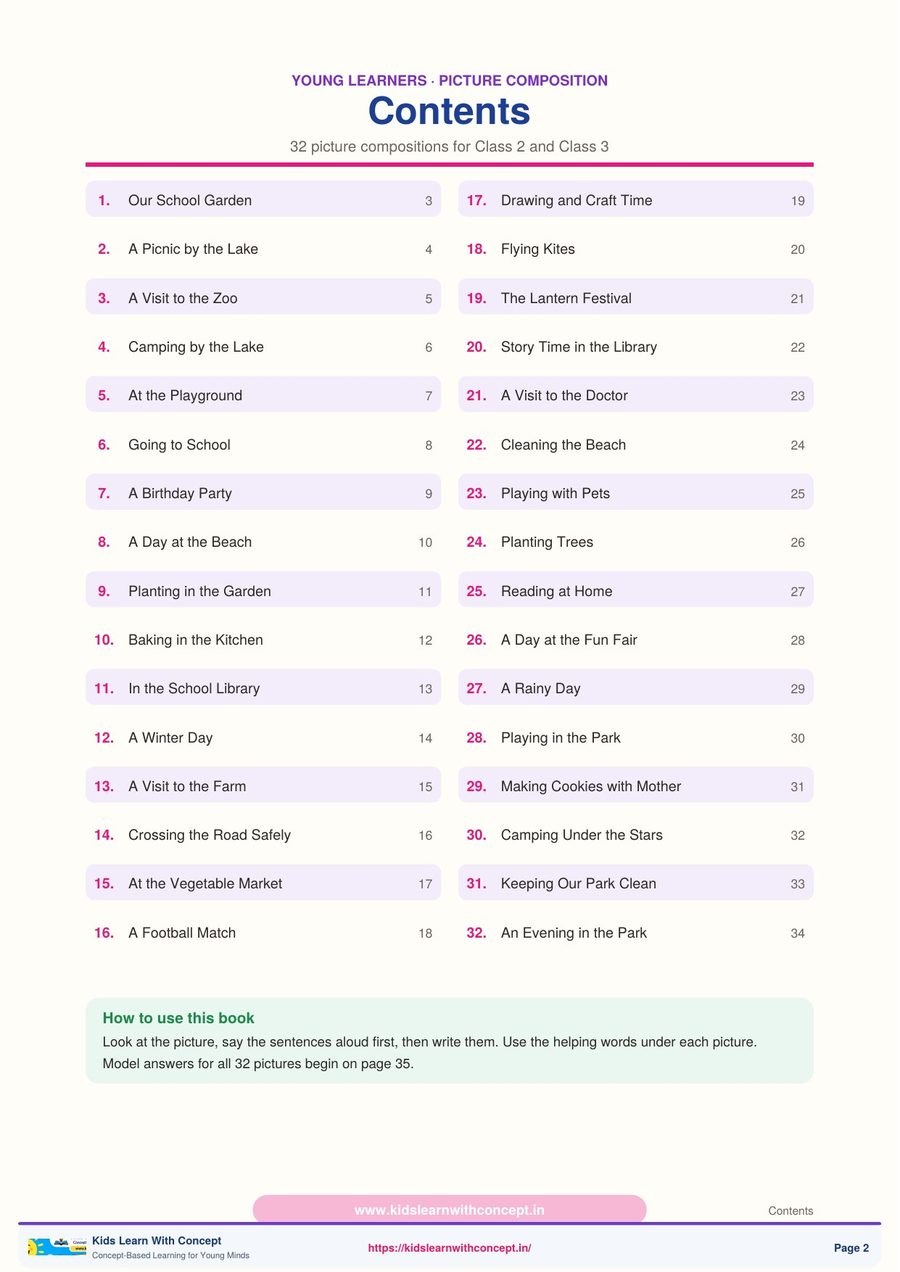
Start with the scenes the child has stood in: the playground, going to school, a birthday party, a rainy day. Save the ones that need imagination — the lantern festival, camping under the stars, cleaning the beach — for when ten sentences has stopped being the hard part. The pictures are not graded in difficulty, so there is no reason to work through them in order.
Model answers, and the better way to use them
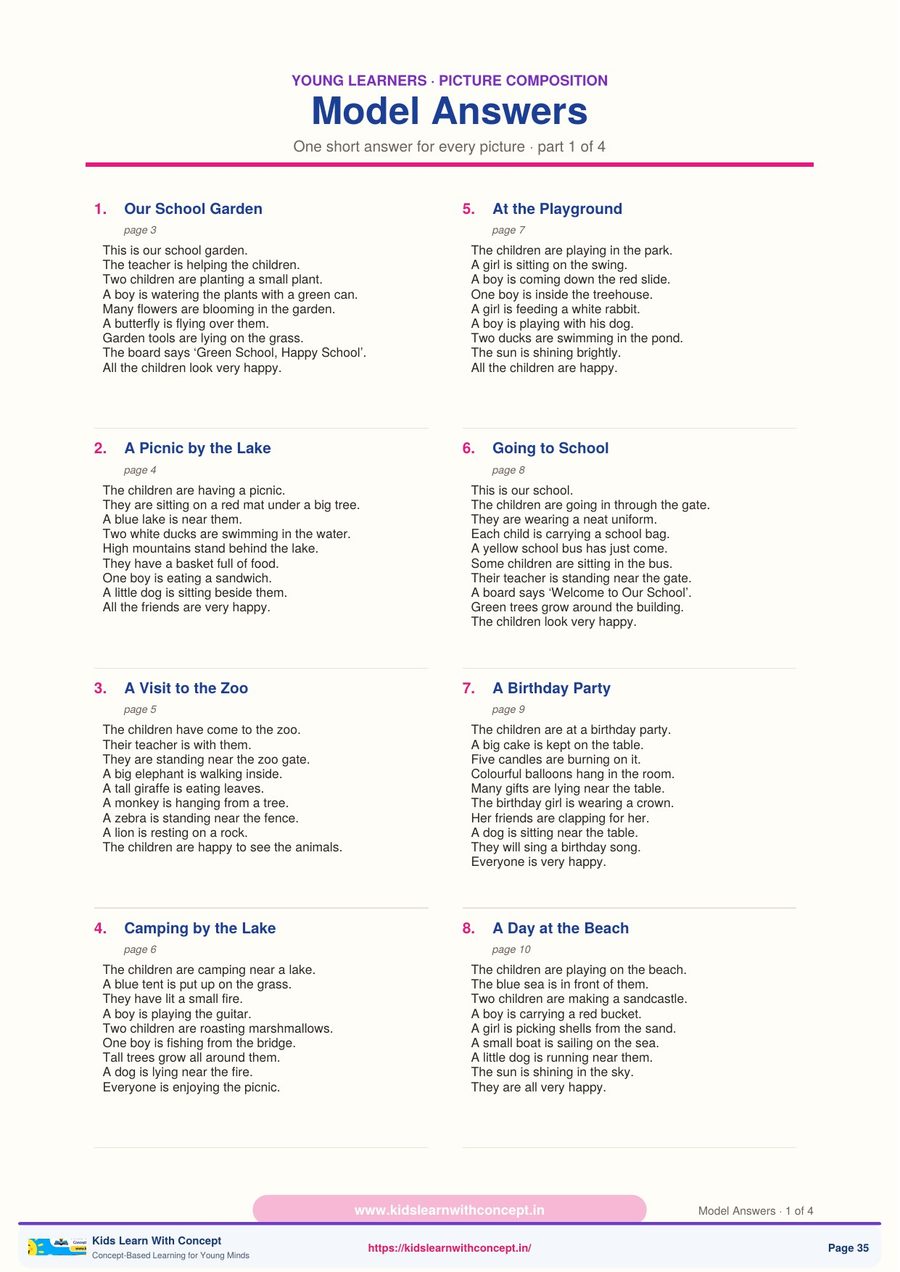
The most useful five minutes in this whole book is not the writing. It is afterwards: put the child's paragraph next to the model and ask “what did the book notice that you didn't?” Not “what did you get wrong” — there is no wrong here. Children will happily hunt for a missed detail, and will go looking for it themselves on the next picture. That is the entire skill.
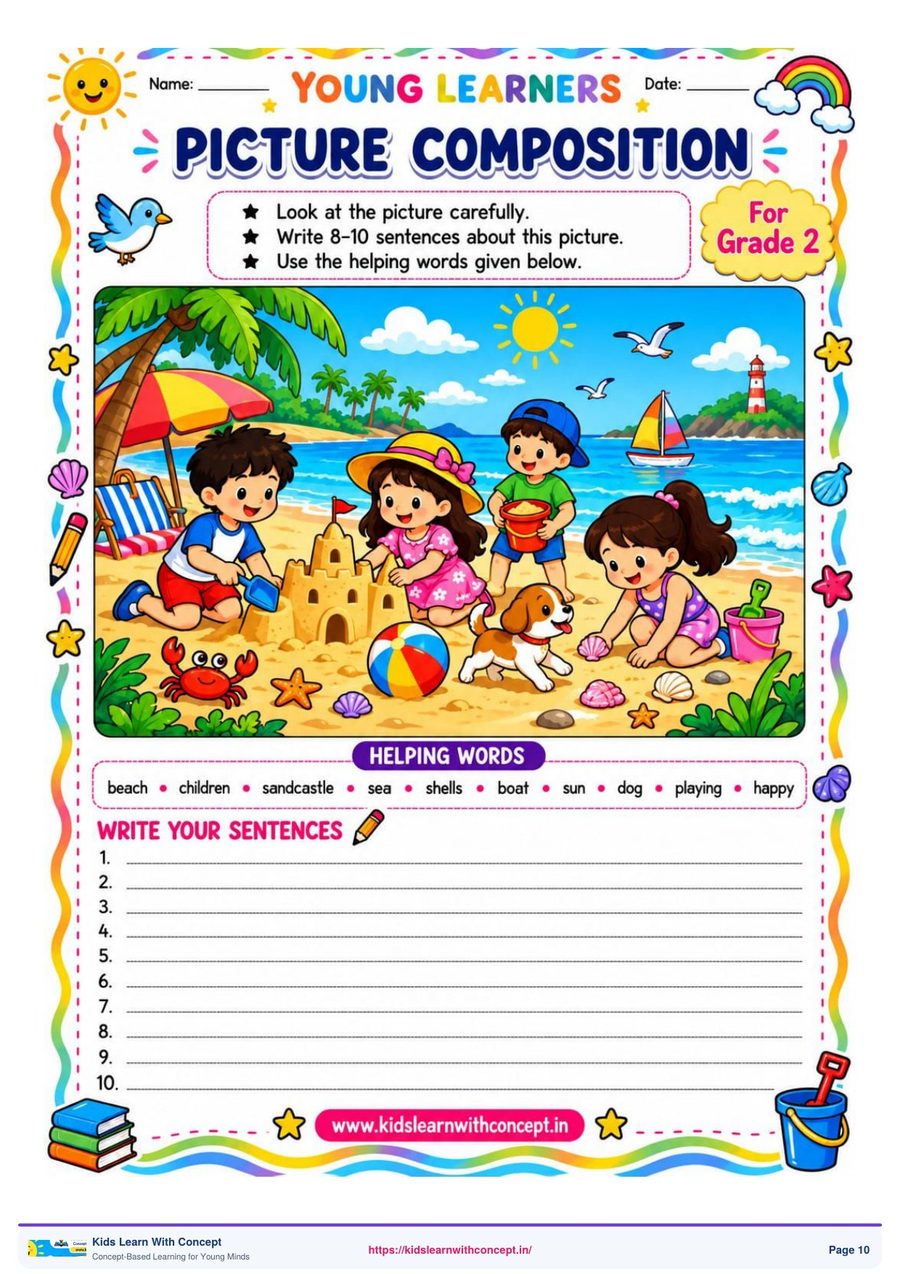
Try two pages free. Two worksheets from this book are in the free Worksheets section — Our School Garden and A Day at the Beach. Print them and try the line-by-line order above before buying anything.
If ten sentences is still too much
Then the Grade 1 step has not finished, and there is nothing wrong with going back to it for a few weeks. Four sentences done confidently is worth far more than ten done unwillingly. The method for that stage is here: Picture Composition for Grade 1 — Four Sentences, Four Questions.